How people think about change
The prevailing metaphor of change is a journey from where we are now to where we want to be.
The desired state of affairs is seen as a place located out there in the future.
The journey towards it will be slow and arduous.
Along the way there will be milestones providing an opportunity to review progress and update plans for reaching the eventual destination.

It’s just a metaphor, and all metaphors are flawed
There is no here, no there, no journey.
Language is rich in metaphor, but all metaphors are fundamentally flawed as they are impoverished representations of reality.Every metaphor breaks down somewhere, or else it would not be a metaphor at all—it would be a strictly literal description! And the options available to us are limited by the very limitations built into the more-or-less arbitrarily adopted metaphor; so people tend to get stuck in their own chosen metaphors, blinded to all the possibilities obscured by the metaphor.
Source: James Wilk speaking with Dave Franzetta, subsequently published in Realizing Possibilities (pdf).
In the following passage, John McWhirter is talking about the metaphors used by psychotherapists in their clinical work. His words should also be heeded by those involved in change endeavours.
Metaphors have a very definite structure. This is sometimes not fully appreciated. To be a metaphor it is necessary that all the components in the metaphor relate in a one-to-one basis to the problem. The ‘key’ to therapeutic metaphors is the accuracy in the ‘isomorphism’ — [i.e.] match. Less accuracy will reduce relevance and therefore the usefulness of the metaphor.
Re-Modelling Metaphors (pdf), by John McWhirter
The journey metaphor is pernicious
It limits our ability to create the desired state of affairs quickly and easily. It misrepresents change as a sequence of discrete stages. And it tricks us into thinking we can map a route from the current state of affairs to the desired state.
Armed with this delusional map we embark on what we imagine will be a long and hazardous journey.
We imagine obstacles that might not really exist.
We believe the milestones we determined are real, and get despondent when they don’t appear on the horizon.
We preclude the possibility that the desired change might be accomplished quickly, with little effort, with existing resources and with minimal disruption.
The change is a journey metaphor is embedded in our mental models and in our language so deeply that it’s almost impossible to talk about change without invoking it.
We must remain alert to its deficiencies.
Some metaphors we could use instead
- Getting married
- Aikido
- The blossoming of a flower
- The butterfly effect
- Curing an illness
- Passing your driving test
- Turning on a light
- Magic
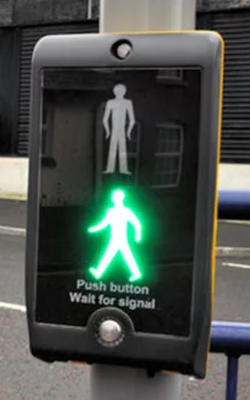
- The green man appearing
- Metamorphosis from caterpillar to pupa, and from pupa to butterfly
- Adding milk to coffee (HT Niels Pflaeging — read more)
- Jesus performing a miracle
- The hundredth monkey effect
- Flowing water taking the path of least resistance
- Turning a key
- Discovering that you’re pregnant
- Entering your password and hitting return
- The domino effect
- Switching the points so that the train proceeds this way rather than that
- Pulling the trigger
- Being a trapeze artist
- White water rafting
- Tapping your heels together three times
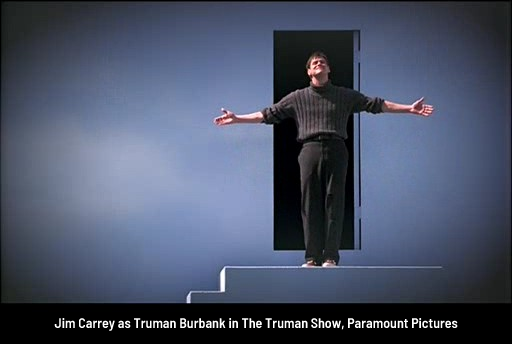
- Truman’s departure from Seahaven
The kaleidoscope metaphor
Imagine that you are looking through the eyepiece of a kaleidoscope and seeing a colourful pattern.
With one tiny nudge of the barrel you instantly see a new pattern. It’s altogether different from the original one and there’s no going back.
Download Kaleidoscopic Change (pdf) by James Wilk.
Change happens in the present, not the future
The past is a footprint left in the sand, the future is a fabrication and the only reality is this present moment.There are three times: a present time about things past, a present time about things present, a present time about things future. The future exists only as expectations, the past exists only as memory, but expectation and memory exist in the present.
Augustine of Hippo, theologian and philosopher
Whether at work or in their personal lives, people want what they want now, not in some hypothetical future that never arrives.
The new reality you want to create is a new Now — desired present, not desired future.
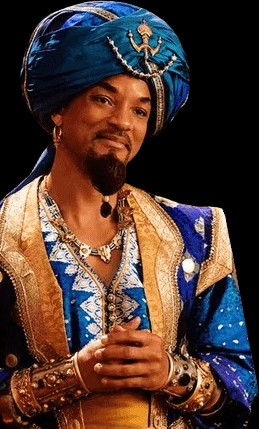
Finding yourself in a strange world, you come across an old oil lamp. As you inspect it, a genie appears and grants you a wish. You describe your desired state of affairs in detail. “Alakazam!” There’s a puff of smoke and your wish becomes reality.
Rigateurs strive to create interventions that get as close to the magic lamp scenario as possible, with the fewest moves.
Read more
Search the site
Not case sensitive. Do not to hit return.