Mundane world
This is the default reality where people spend most of their waking lives.
Carlos Castaneda and his teacher don Juan Matus call it the tonal — or first attention, a term also used by Iain McGilchrist.
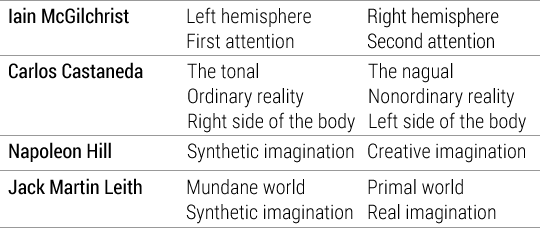
Mundane world is a world of descriptions. If something can be named, described and explained, it is part of this reality.
It is is the sum total of everything we know and everything the rational mind can imagine.
The first attention basically consists of everything that ordinary man considers it means to be human. It is the reality that has been constructed and developed in order to deal with the daily world and encompasses an awareness restricted to the physical body.
Lorraine Voss PhD, Female Warrior | view
An ordinary man sees the world as it is, as he’s been taught, conditioned and instructed to see it. A warrior sees the lines of the universe and knows the interconnectedness of all things.
don Juan Matus via Carlos Castaneda and Lorraine Voss
[don Juan] smiled and winked at me [Castaneda].“I’m using your own words now,” he said. “The tonal is the social person.”
He laughed, I supposed, at the sight of my bewilderment.
“The tonal is, rightfully so, a protector, a guardian – a guardian that most of the time turns into a guard.”
I fumbled with my notebook. I was trying to pay attention to what he was saying. He laughed and mimicked my nervous movements.
“The tonal is the organizer of the world,” he proceeded. “Perhaps the best way of describing its monumental work is to say that on its shoulders rests the task of setting the chaos of the world in order. It is not farfetched to maintain, as sorcerers do, that everything we know and do as men is the work of the tonal.”
“At this moment, for instance, what is engaged in trying to make sense out of our conversation is your tonal; without it there would be only weird sounds and grimaces and you wouldn’t understand a thing of what I’m saying.”
“I would say then that the tonal is a guardian that protects something priceless, our very being. Therefore, an inherent quality of the tonal is to be cagey and jealous of its doings. And since its doings are by far the most important part of our lives, it is no wonder that it eventually changes, in every one of us, from a guardian into a guard.”
Excerpted from the book Tales of Power by Carlos Castaneda. See also The totality of oneself: the tonal and the nagual elsewhere on this website
You have to understand that there are dimensions. In the dimension we call the world1, a person needs logic. He needs it badly. He needs to be able to analyze and take apart things and put them back together again. He needs to spot flaws in reasoning and multiple deceptions. He needs to recognize formal arguments and trace them all the way through from assumptions to conclusions. But in the dimension where creative power operates2, where things happen that most certainly impact this world, all bets are off. He needs to understand and experience and launch a kind of vast freedom for his own imagination that takes him entirely out of the realm of being a normal person, a foolish and provincial “realist,” a mechanically thinking human. He has to go light-years past that. He has to stop pretending he is some kind of scientist. In other words, he has to stop burying his own power. Two dimensions, two capabilities.
Jon Rappoport, The Magician Awakes, cited in The Space, the Magician, and the Man of Science, also by Jon Rappoport
1, This is what I call mundane world.
2. I call this primal world.
The thesis is that one of the Buddha’s disciples, Avalokiteśvara, realises that to overcome suffering he must recognise that the five skandhas – things that make up the human experience – are empty. The skandhas are:
Form, all the things our sensory organs can smell, taste, see, feel and hear.
Feelings that arise when we perceive things.
Perception is the lens through which we label things and assign value or worth like bananas are delicious or this article is boring.
Mental forces, or volition, are the actions and reactions to things and the feelings and perceptions that come from them.
Consciousness is the last because it its the aggregate or heap of the rest together. It is our memories and the human hard drive from which we draw from to inform how we will respond to new forms, feelings and sensations.
Buddhists believe that human experience is a culmination of these things, and outside your own cognition there’s no certainty anything exists.* * *
Because our senses are so limited and the nature of all things so transient, what we know to be objective reality is a momentary snapshot of the whole picture. To realise the five skandhas are empty is to give yourself a chance to see reality as it is, rather than reality as we think it should be.
Don’t believe everything you see: why Buddhist scepticism is vital in the age of generative AI by Bertin Huynh on The Guardian website
Primal world
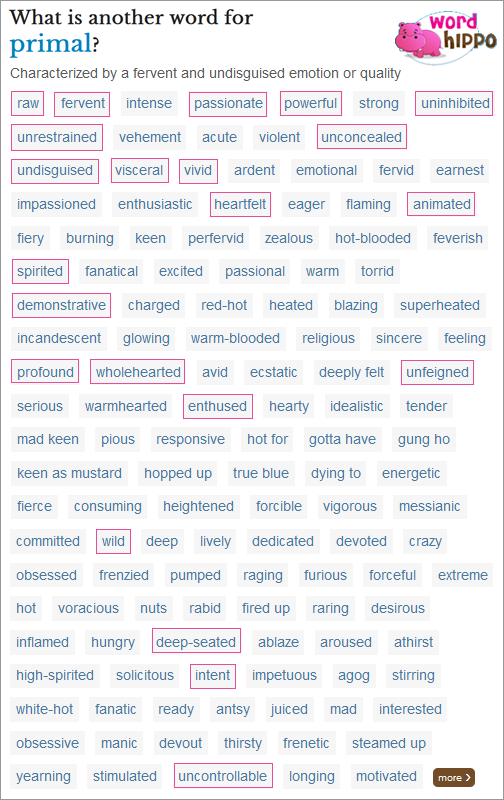
Primal synonyms and related terms | Source: WordHippo
In this reality there is only pure perception and visceral experience.The terms pure perception and primal world are more or less synonymous.
When you are in primal world you are part of the natural world and in harmony with the flow of the universe.
All is one. There are no discrete things and therefore no names and no descriptions.
[Don Juan Matus …] used the term “nagual” to signify that part of perception which is in the realm of the unknown yet still reachable by man, implying that, for his party of seers, don Juan was in some way a connection to that unknown. Castaneda often referred to this unknown realm as nonordinary reality, which indicated that this realm was indeed a reality, but radically different from the ordinary reality experienced by human beings who are well engaged in everyday activities as part of their social conditioning. Ordinary reality as experienced by humans was simply a “description” that had been pounded into their awareness since they were infants.Source: Carlos Castaneda by Graeme Wilson, The Will Project
Everything I have written about primal world is a grossly impoverished representation of the idiosyncratic experience of primal world.
Read more
External sources
This website
Pure perception — what it is, why it matters and how to attain it
Index to entire site
Search the site
Not case sensitive. Do not to hit return.