As work becomes ever more collaborative and project based, so the critical importance of meetings increases.
Some kinds of meeting are efficient and effective when held online via Teams or Zoom.
But certain types of meeting require people to be physically present, particularly those in which participants from diverse stakeholder groups must establish shared intent and initiate concerted action.
In a few moments I’ll outline three suitable meeting formats that you may wish to deploy.
But first, the Max4 Principle.
The Max4 Principle
Meetings convened by Now-to-New wayfarers observe what I call the Max4 Principle:
The maximum group size for a natural conversation is four.
Five is just about OK. In groups with six or more participants, one or two people are likely to dominate, some may be excluded from the conversation and group energy will be low.
Best: four people.
Second best: three people.
Absolute maximum: five people
The principle was discovered by conversational leadership practitioner and Knowledge Café (aka Gurteen Knowledge Café) originator David Gurteen through his experiments with various configurations of Café participants.
Three academic research studies support his findings.
Read more about the research studies
Three types of meeting for initiating and advancing your Now‑to‑New project
| TYPE | DESIRED OUTCOME | SPECIFICALLY | FORMAT | DURATION | MAX SIZE |
|---|---|---|---|---|---|
| 1A | UNDERSTANDING Basic | We want people to get to grips with the issue and gain a basic understanding | Knowledge Cafè | Two hours | 48 |
| 1B | UNDERSTANDING Deep | We want people to explore the issue from different angles and gain a deep understanding | OpenSpacePlus (Open Space / Knowledge Cafè hybrid) | Day | No upper limit |
| 2 | COLLABORATIVE ACTION | We want stakeholders to grasp the nettle, establish shared intent and initiate sustained collaborative action | OpenSpacePlus embedded in custom-designed activities | Day or longer | No upper limit |
Type 1: Meetings for understanding
Version A: foster basic understanding
Desired outcome
“We want people to get to grips with the issue and gain a basic understanding.”
Meeting format
Knowledge Café.
Originator: David Gurteen, pictured below.
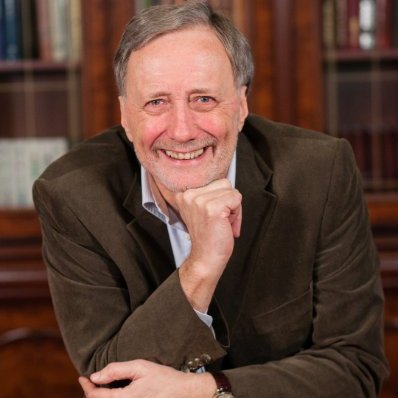
David Gurteen ran his first Knowledge Café in September 2002 as an antidote to the ‘death by powerpoint’ style of conference session, aiming to foster more natural conversation and knowledge sharing through dialogue rather than formal presentations. He has hosted Knowledge Cafés in more than 30 countries.
What happens

- Café host welcomes participants, states the purpose of the Knowledge Café, explains the procedure, gives a brief talk (20 minutes maximum) and introduces a thematic question.
- Participants break into groups of four and have a conversation in response to the question.
- New groups of four are formed and conversations continue.
- When sufficient time is available, a third round of conversations takes place in new groups of four.
- Chairs are rearranged to form a circle. Participants take their seats and a discussion begins. Host ensures that all voices are heard and that no one dominates the discussion.
- Host thanks participants for their contributions and closes the Café.
Some points to note
- No flipcharts are used. Individual note taking is OK but flipchart capture and subsequent report-outs hinder effective conversation.
- The opening session can be extended to 30 minutes maximum if a longer introduction is necessary, but the duration of the talk should be no more than 20 minutes.
- Facilitation during the final session requires a light touch.
- The host does not invite or answer questions.
How to form the small groups
Ask participants to form groups of four, choosing people they don’t already know.
Unless the total number of participants is divisible by four, there will be one, two or three people remaining.
If three people remain, they form a group of three.
If two people remain, each joins a group of four.
If one person remains, he or she joins a group of four.
Repeat this procedure for each round.
No more Q&A sessions
Whenever you are planning to give a talk or PowerPoint presentation followed by a Q&A session, consider hosting a Knowledge Café instead. You will need more time but participants will have a richer and more rewarding experience.
Will assistance be needed?
You may need help with your first meeting. I can provide support.
Version B: foster deep understanding
Desired outcome
“We want people to explore the issue from different angles and gain a deep understanding.”
Meeting format
OpenSpacePlus (Open Space / Knowledge Café hybrid).
The format underpins a day-long meeting with no upper limit to the number of participants.
Open Space is a type of meeting in which participants create their own programme of self-facilitated sessions in response to a compelling thematic question.
The format was devised by Harrison Owen (1935–2024, view obituary) in order to create better conferences — initially, the Third International Symposium on Organization Transformation, which was held in Monterey, USA in 1985.
An Open Space meeting has no pre-determined agenda. Instead, participants are presented with an empty grid showing times to meet along one axis and places to meet (often just circles of chairs) along the other.
They populate this grid with impromptu self-managed sessions. Each session is some kind of response to the thematic question. The photo shows Peter Troxler, a participant in an Open Space meeting on the topic of knowledge management, announcing his session: Who owns the K in KM?
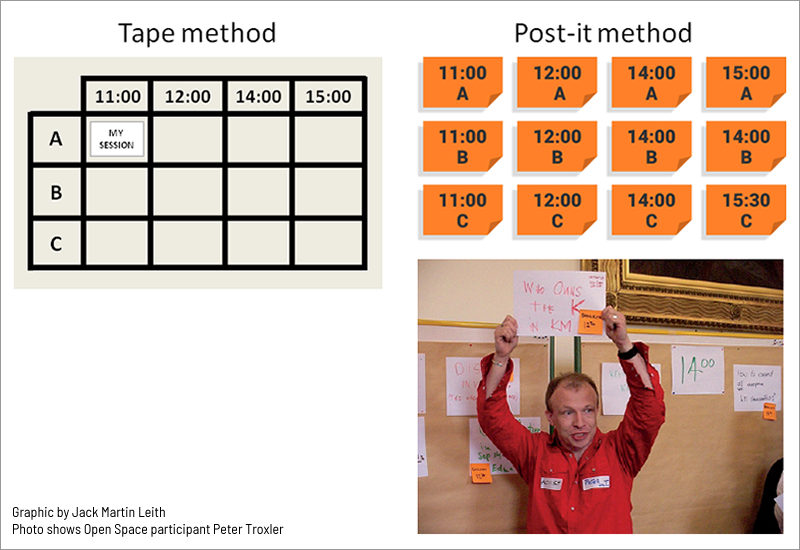
Although Open Space is sometimes used with the aim of initiating sustained collaborative action, this can be wishful thinking unless the Open Space forms part of a larger meeting, bookended with pre‑designed and choreographed activities. Now-to-New meetings for collaborative action (outlined below) are structured in this way.
Open Space is a popular and effective meeting format that has been used around the world by a rich assortment of businesses, government institutions and nonprofits. Since experiencing Open Space for the first time in 1988, just three years after its inception, I’ve led Open Space meetings for Diageo, Engineering Council, European Commission, McCain Foods, NHS, Shell, University of Brighton and many other organisations.
The strength of Open Space is enabling participant-led conversations related to a thematic question, when these are conversations for illumination rather than conversations for action.
Alongside this strength, the textbook Open Space format has a significant deficiency. The breakout groups often have more than five members, with the consequences I mentioned earlier.
I remember an occasion during a two-day, 1,000 person Open Space event for Bosch in Caen, France where I was assisting the facilitator, Chris Schoch. There was a session with so many participants that we had to find them a PA system.
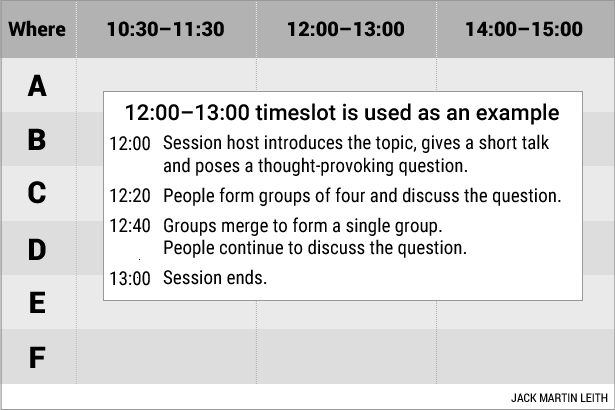
The deficiency is easily eliminated by having session hosts follow the Knowledge Café format.
Here’s an indicative example.
Will assistance be needed?
You will almost certainly need help with the first meeting or two. I can provide support.
Type 2: Meetings for collaborative action
Desired outcome
“We want stakeholders to grasp the nettle, establish shared intent and initiate sustained collaborative action.”
Meeting format
Unlike meeting types 1A and 1B, which have a fixed format, every type 2 meeting is custom designed. The only fixed feature is an OpenSpacePlus element in which the participants respond to a bespoke thematic question, as illustrated in the image below.
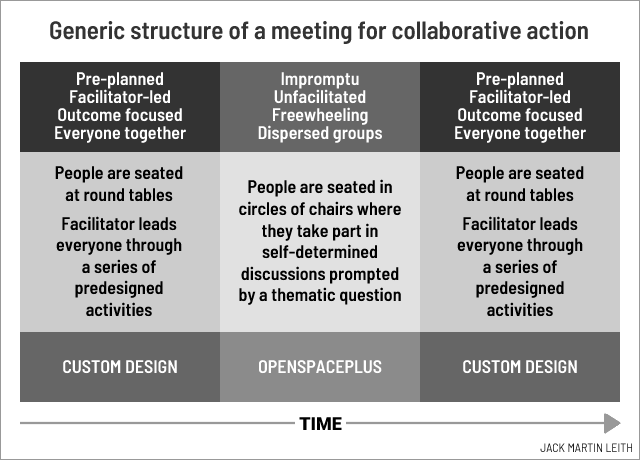
The positioning of the OpenSpacePlus element within the agenda, its purpose and its thematic question are determined by the purpose and desired outcomes of the meeting as a whole.
This is the conceptual foundation of a meeting for collaborative action:
Diverse voices > Shared intent > Concerted action.
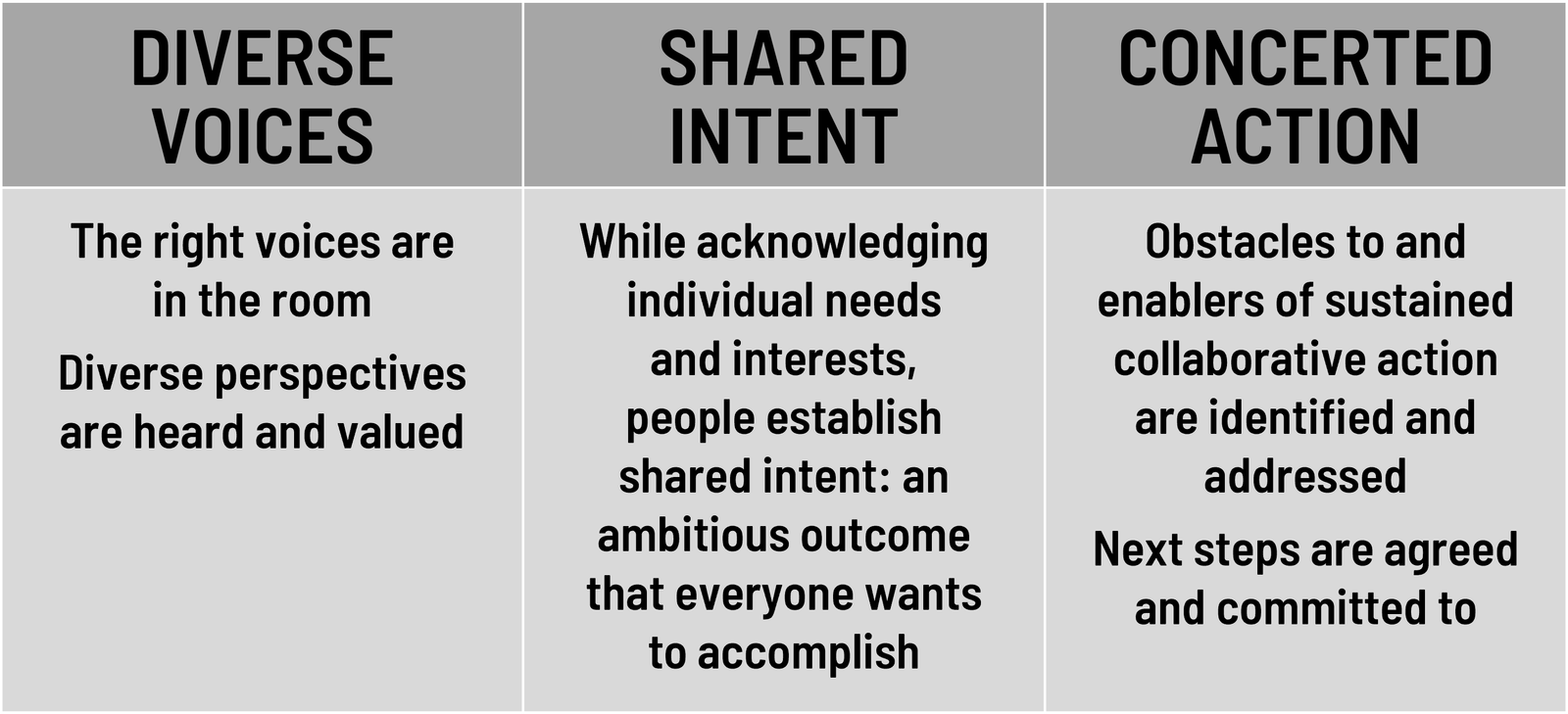
This sequence is independent of the one seen in the previous image | What is intent?
Is this just Future Search without the label?
No. A Future Search conference has a fixed format, and it’s one I know well (view graphic).
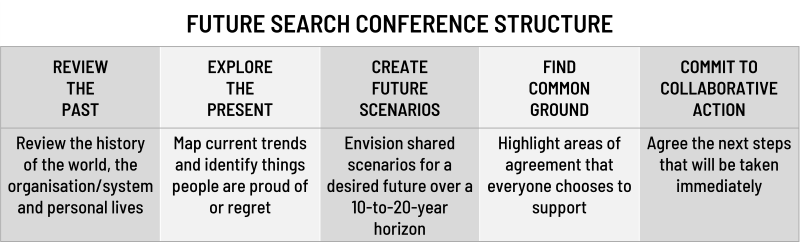
Meetings for collaborative action are custom designed. The meeting that emerges might look something like a Future Search, but it will be based on principles derived not only from Marvin Weisbord and Sandra Janoff, but also from other people named below.
Theoretical underpinnings
Meetings for collaborative action are informed in large part by the work of Kurt Lewin, Fred Emery, Merrelyn Emery, Eric Trist, Ron Lippitt, Marvin Weisbord, Sandra Janoff, Kathie Dannemiller, Paul Tolchinsky, Robert ‘Jake’ Jacobs, David Gurteen and Harrison Owen.
Will assistance be needed?
The design and facilitation of this kind of meeting requires finesse so yes, you will need assistance.
Do you need any support?

With my professional work in the field starting around 1990, I bring knowledge, know-how and experience that cannot be found elsewhere.Jack is an exemplar of collaboration, taking us from now to new on expeditions that can take a day and yet can have all the richness and excitement, learning and challenge of a safari through personal and organisational jungles.
Paul Levy, Senior Lecturer, School of Business and Law, University of Brighton (view profile)
You can contact me by email, text or contact form.
Read more
Search the site
Not case sensitive. Do not to hit return.