Design thinking
In the 1990s, David Kelley and Tim Brown of the global design and innovation company IDEO, along with strategy exponent Roger Martin, brought together principles, concepts and methods that had been brewing for many years and distilled them into a unified concept, which they named design thinking.
Design thinking consists of five non-linear, iterative phases or types of activity: Empathize, Define, Ideate, Prototype, and Test. Nielsen Norman Group adds a sixth phase, Implement. Others use different labels, or include additional phases, or both.
In 2022, IDEO adopted a six-aspect design thinking process: Frame a question; Gather inspiration; Generate ideas; Make ideas tangible; Test to learn; Share the story. The firm also talks about “the three core activities of design thinking: Inspiration, Ideation and Implementation”.
In the Harvard Business Review explainer video below (runtime 2:23), a three stage process is presented:
- Invent a future. Observe and ask questions.
- Test ideas and adjust.
- Bring the new product or service to life.
Design thinking is not a codified method, but rather a way of thinking and acting. Each consulting firm, corporate team or entrepreneur will do design thinking in their own way using their own methods, but most design thinking projects will look something like this:Design thinking is both an ideology and a process that seeks to solve complex problems in a user-centric way. It focuses on achieving practical results and solutions that are:
- Technically feasible: They can be developed into functional products or processes;
- Economically viable: The business can afford to implement them;
- Desirable for the user: They meet a real human need.
What is design thinking, and how do we apply it? originally on InVisionApp website
- The needs and concerns of the intended customers or users are kept to the fore.
- Work is undertaken by a multidisciplinary team.
- Work is nonlinear and iterative.
- Experimentation is encouraged. Testing and prototyping begin early.
- There are multiple periods of diverge-converge work. Some refer to each period as a diamond — see for example the Design Council’s Double Diamond framework.
- Brainstorming or one of its derivatives is the primary idea generation method.
Osborn Parnes Creative Problem-Solving Process
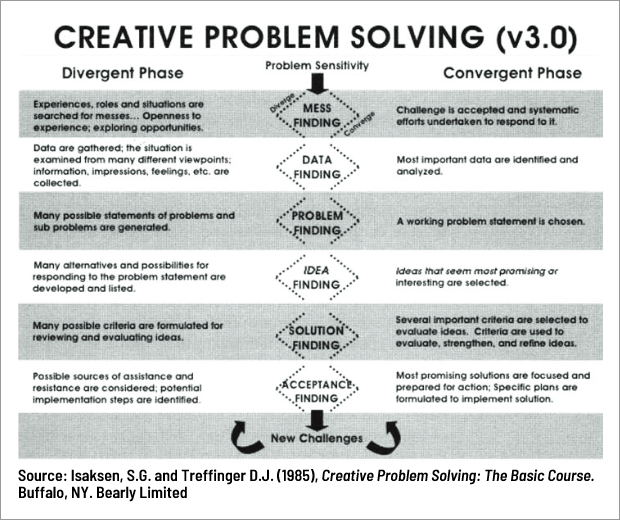
Alex Osborn and Sid Parnes introduced their Creative Problem Solving Process in the 1960s. An early version consisted of five steps: Fact-finding, Problem-finding, Idea-finding, Solution-finding, and Acceptance-finding. In 1994, Scott G. Isaksen and Donald J. Treffinger added a sixth step, Mess-finding, to precede Fact-finding.
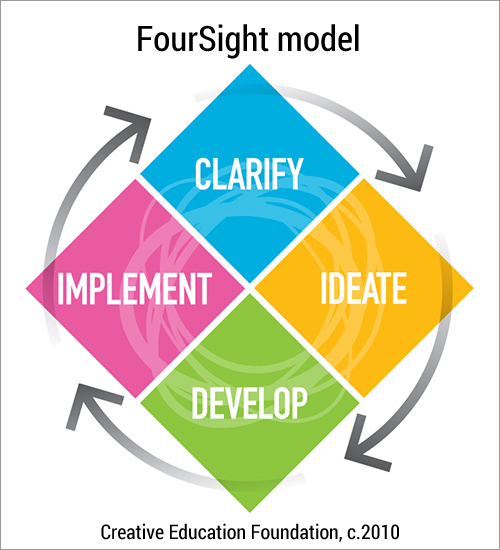
Around 2010, Creative Education Foundation, which was established by Osborn in 1954 and later led by Parnes, reduced the process to four steps: Clarify, Ideate, Develop, Implement.
Read more
Creative Problem Solving Resource Guide (pdf) by Creative Education Foundation
Theory U
Developed by Otto Scharmer, Theory U is an awareness-based change framework that guides individuals and groups through a U-shaped process of sensing, presencing and co-creating to enable deep systemic transformation.
Otto Scharmer is a senior lecturer at MIT, co-founder of u-school for transformation and author of Theory U: Leading from the Future As it Emerges.
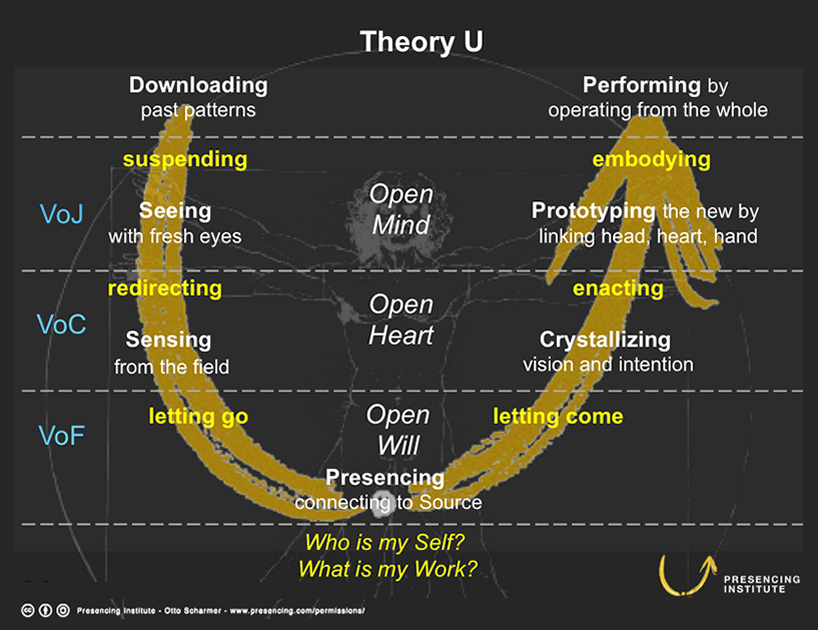
VoJ is Voice of Judgment, VoC is Voice of Cynicism, and VoF is Voice of Fear | Click on image or here to enlarge
Key capacities to cultivate1. Holding the space: Listen to what life calls you to do, creating a safe and open environment for dialogue and shared exploration.
2. Observing (Open Mind): Suspend the Voice of Judgment and past cognitive schema. Attend to the current reality with a mind wide open. This means truly seeing the world outside your ‘bubble’ with fresh eyes.
3. Sensing (Open Heart): Suspend the Voice of Cynicism. Connect with your heart and see things as interconnected wholes, developing empathy for others and for the entire system. Go to the ‘places of most potential’ and listen deeply.
4. Presencing (Open Will): Suspend the Voice of Fear. This is the core threshold at the bottom of the U. It involves letting go of old habits, beliefs, and non-essentials (like a camel passing through the ‘eye of the needle’ after unloading its burdens) and opening yourself to your highest future possibility. In a place of stillness and reflection, you connect to a deeper source of inspiration and allow ‘inner knowing’ to emerge.
Theory U is informed by the work of Rudolf Steiner, W. Brian Arthur, Joseph Jaworski, Bernard Lievegoed and others.
The original U procedure was devised by Friedrich Glasl, an Austrian conflict researcher and organisational consultant best known for developing Glasl’s Nine-Stage Model of Conflict Escalation (pdf).
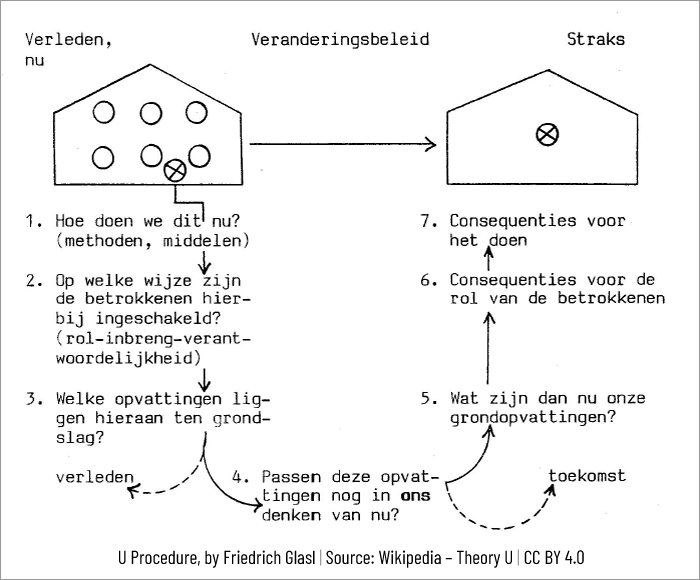
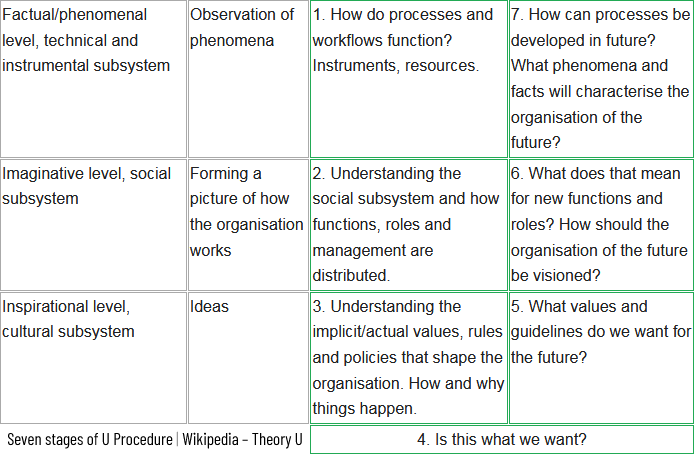
According to Eugene Schwartz, the origin of the U-shaped form can be traced back to Rudolf Steiner, the originator of Anthroposophy.The earlier work by Glasl involved a sociotechnical, Goethean and anthroposophical process involving a few or many co-workers, managers and/or policymakers. It proceeded from phenomenological diagnosis of the present state of the organisation to plans for the future. They described a process in a U formation consisting of three levels (technical and instrumental subsystem, social subsystem and cultural subsystem) and seven stages beginning with the observation of organisational phenomena, workflows, resources etc., and concluding with specific decisions about desired future processes and phenomena. The method draws on the Goethean techniques described by Rudolf Steiner, transforming observations into intuitions and judgements about the present state of the organisation and decisions about the future. The three stages represent explicitly recursive reappraisals at progressively advanced levels of reflective, creative and intuitive insight and (epistemologies), thereby enabling more radically systemic intervention and redesign. The stages are: phenomena – picture (a qualitative metaphoric visual representation) – idea (the organising idea or formative principle) – and judgement (does this fit?). The first three then are reflexively replaced by better alternatives (new idea –> new image –> new phenomena) to form the design design [sic].
Source: Wikipedia – Theory U
I have much respect for Otto Scharmer and am reluctant to say anything negative about Theory U, which is artfully conceived and superbly articulated.Theory U draws its name from the U-shaped form that appears throughout [Otto Scharmer’s book Theory U: Leading from the Future As it Emerges]. The form is, of course, familiar to students of Rudolf Steiner as the curve that traces the human soul’s descent into matter and its eventual ascent to the spirit in the course of a single lifetime. In Scharmer’s hands it takes on myriad meanings, all of them emblematic of the transformative experiences that organizations—and the human beings who shape the organizations and are in turn shaped by them—must undergo to become viable entities.
Eugene Schwartz, Anthroposophy and Waldorf Education: Of Prophets and Profits — A Review of Theory U: Leading from the Future as It Emerges, by C. Otto Scharmer | This is no longer available online so please contact me if you would like to receive it as a Word document
However, I find the U figure misleading as the connection to Source would, in my view, be better depicted as an upward motion towards the heavens (“ascent to the spirit”) rather than a downward one towards terra firma (“descent into matter”).
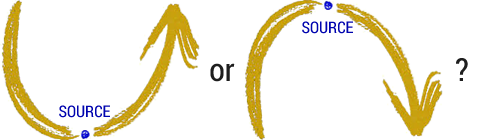
Metaphors convey meaning, visual ones included, and I contend that people in the western world typically situate ‘Heaven’ above their heads and ‘Earth’ beneath their feet. But this is a minor quibble and even if Otto Scharmer wanted to invert the U, the ramifications would render this close to impossible.
Read more
Leading from the Future: A new social technology for our times, by Otto Scharmer, on Systems Thinker website
u-school: Methods and Tools for Social Transformation — highly recommended
Read more
External sources
The Collaborative Impact Methods Kit — 500+ techniques and tools to unleash collective change, curated by Fito Network
Innovation Methods Mapping by GK Van Patter and Elizabeth Pastor, co-founders of design firm Humantific
Liberating Structures — a collection of 35 methods [view] including the preposterously-named TRIZ, which is unrelated to the bona fide one listed below.
Synectics — a facilitated upstream workshop, widely used in the late 20th century.
TRIZ — a pattern-based approach to technical innovation and problem solving.
This website
Search the site
Not case sensitive. Do not to hit return.