
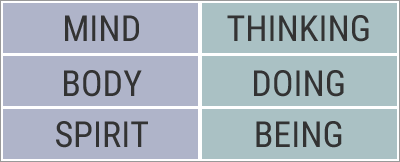
Models are useful but they are maps, not the territory we experience.
If the Now-to-New Project Model is to resemble the real world more closely, there has to be a corresponding one that lives in the body, as depicted below.
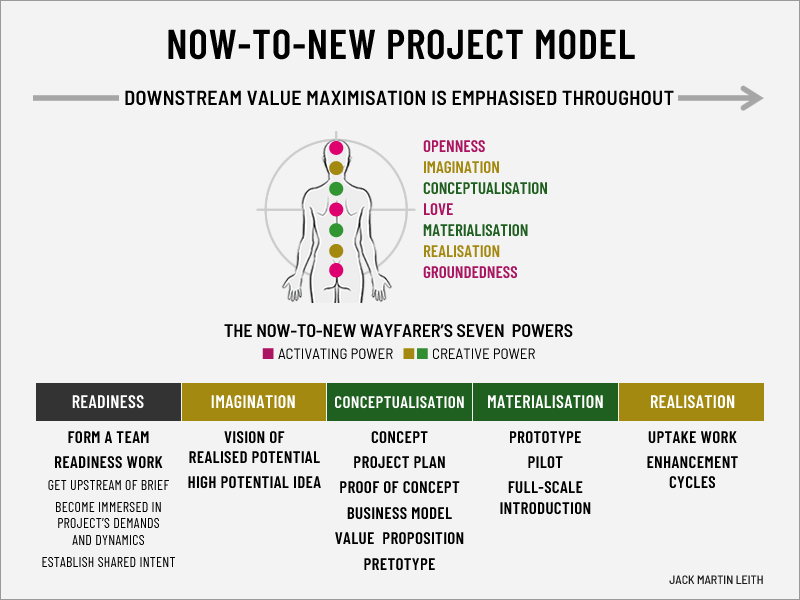
This is the relationship between creative power and Now-to-New Project Model component:
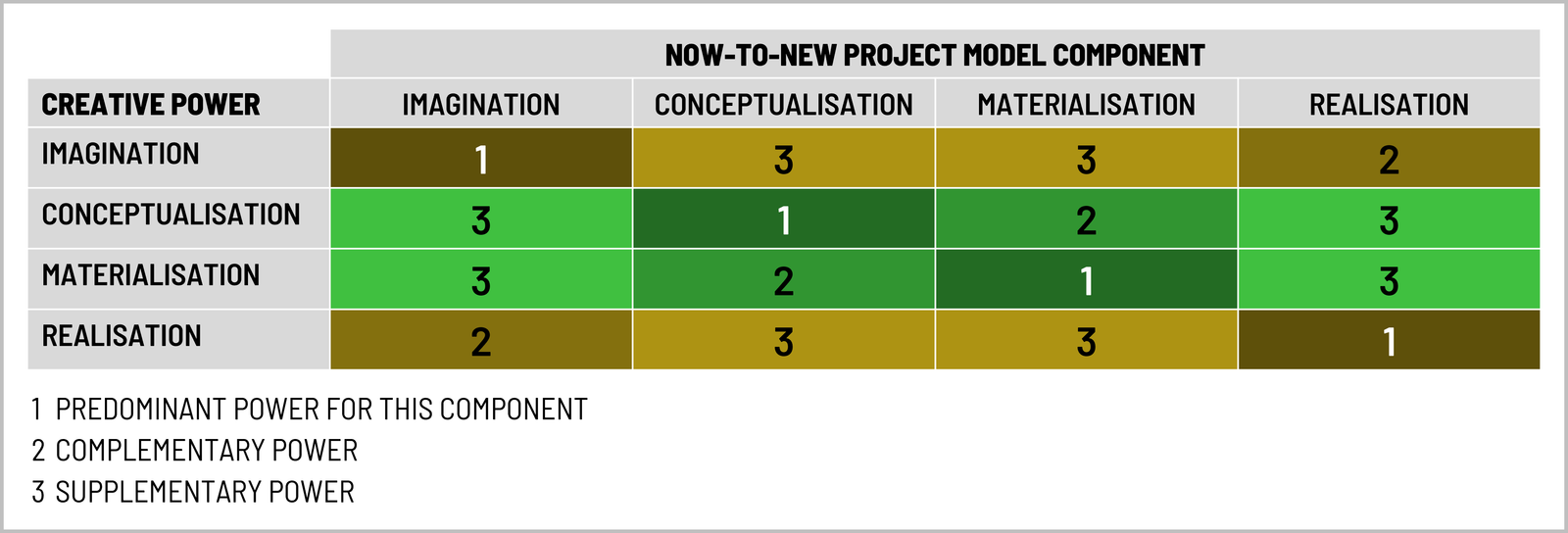
The integrated model is the result of the extensive research, deliberation, experimentation and real world testing I undertook over the course of 45 years.
In the next image you can see that the embodied Now-to-New model incorporates mind (horizontal plane), body (vertical) and spirit (magenta items), channelled via the Openness–Love–Groundedness triad.
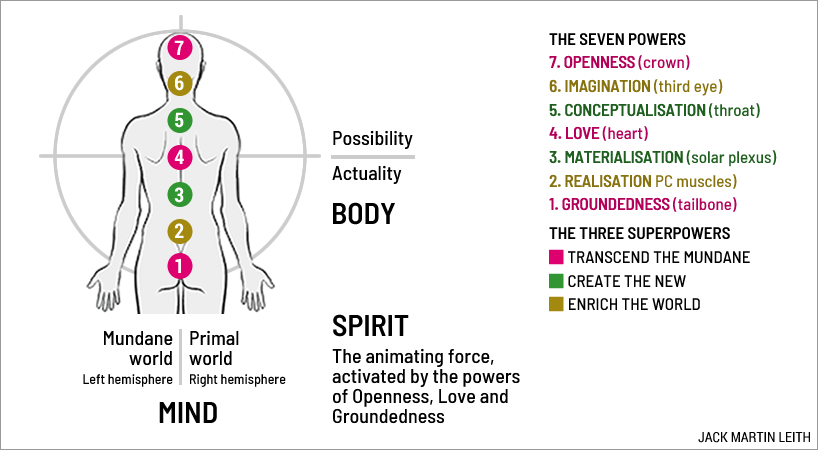
Be aware that mind-body-spirit is nothing more than a convenient fiction. Every one of us is an undivided whole, and the abstracted parts work together in ways we will never fully understand.
It is important to maintain the awareness that the systems view itself is also just another map that, as Alfred Korzybski put it, should not be confused with the territory. We can reduce the world to a whole just as easily as we can reduce it to a collection of parts.
Daniel Christian Wahl, [6 Key Questions in] Whole Systems Thinking, an excerpt from this book, Designing Regenerative Cultures
Jump ahead
Read about the Now-to-New wayfarer’s:
 Mind
Mind
Body
Spirit
The Now-to-New wayfarer’s mind
Mind is represented by the horizontal plane.
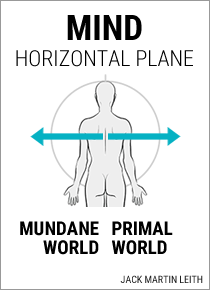
The comparison chart below is based in part on the work of Iain McGilchrist, a psychiatrist, neuroscientist and writer best known for his brain lateralization hypothesis. This supersedes the debunked yet still prevalent split-brain theory developed in the 1960s by Roger Sperry and others.
Each hemisphere brings forth a distinct world or perception of reality.
Iain McGilchrist talks about two worlds without naming them.
Carlos Castaneda calls them the tonal and the nagual.
I use the terms mundane world (everyday world, default reality) and primal world (nonordinary reality, an indescribable place of pure perception).
| MUNDANE WORLD Brought forth by brain’s left hemisphere | PRIMAL WORLD Brought forth by right hemisphere |
|---|---|
| Power and control are prevalent | We are in the flow of life |
| We seek certainties | Living in faith — the ability to proceed despite uncertainty — we imagine tantalising possibilities |
| Everything can be named, described and situated on the arrow of time | As soon as we name something it becomes a thing and therefore part of mundane world “The Tao that can be told is not the eternal Tao” —Tao Te Ching There is no arrow of time, only the present moment |
| Our lives are experienced at one stage removed, like watching a video rather than the live performance | Life is visceral and experienced in the raw: unfiltered, uncodified and unconceptualised |
| We know the map | We know the territory |
| Abstract concepts are treated as actual things that can be created and manipulated | Abstraction, reductionism and reification are absent |
| Generative thought and action are constrained by a barrage of rules, norms, mores, codes, beliefs, dogmas, narratives and ideologies | Life is visceral and experienced in the raw: untamed, unfiltered, uncodified and unconceptualised |
| We are domesticated and apart from nature | We are untamed and part of nature |
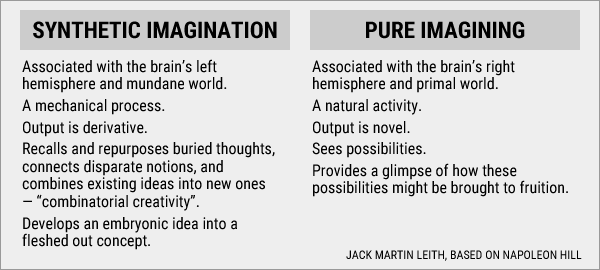
| We deploy synthetic imagination | We deploy natural imagining |
Two forms of imagination
Read more
Iain McGilchrist and his brain lateralisation hypothesis
Jill Bolte Taylor, a neuroscientist who experienced her brain’s left hemisphere shutting down
Synthetic imagination and natural imagining
The Now-to-New wayfarer’s body
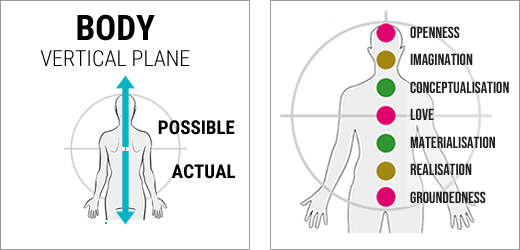
Body is represented by the vertical plane.
Seven powers
Now-to-New wayfarers have at their disposal seven powers, each associated with a particular part of the body.
These are outlined in the table below.
How I identified the Now-to-New wayfarer’s seven powers
Three superpowers
The three activating powers (coloured magenta in the previous image) combine to form a superpower named Transcend the Mundane.
The four creative powers (coloured green and gold) combine in pairs to form two further superpowers: Create the New and Enrich the World.
When Transcend the Mundane is activated, the other superpowers also become active with their constituent creative powers ready to be deployed.
| POWER | TYPE OF POWER | PART OF SUPERPOWER | PURPOSE | ASSOCIATION 1 |
|---|---|---|---|---|
| OPENNESS | Activating | Transcend the Mundane | Connecting to the nonmaterial realm — ‘Heaven’ | Crown |
| IMAGINATION | Creative | Enrich the World | Imagining a world enrichment possibility and a way of actualising it | Third eye 2 |
| CONCEPTUALISATION | Creative | Create the New | Devising something 3 that will generate the imagined value | Throat |
| LOVE | Activating | Transcend the Mundane | Experiencing an ever-present desire to be of service and to enrich the world | Heart |
| MATERIALISATION | Creative | Create the New | Giving the creation 3 tangible form and introducing it to the world at large | Solar plexus 4 |
| REALISATION | Creative | Enrich the World | Bringing the creation to fullness and realising its value generation potential | PC muscles 5 |
| GROUNDEDNESS | Activating | Transcend the Mundane | Connecting to the material realm — ‘Earth’ | Tailbone |
1. This refers to a metaphorical association, not a literal location.
2. The mythical third eye is located between and just above the eyebrows.
3. The new creation might be a product, a service, a facility or some other form of value generator.
4. Situated below the diaphragm and above the navel.
5. The PC (pubococcygeus) muscles are what we use to control urine flow.
From possibility to actuality
The powers located above the heart (Openness, Imagination and Conceptualisation) are for envisioning possibilities, conceiving high potential ideas and elaborating the ideas into concepts.
The powers located below the heart (Materialisation, Realisation and Groundedness) are for evolving concepts into fully-formed value generators, introducing them to the world, bringing them to fullness and realising their value generating potential.
The Now-to-New wayfarer’s spirit
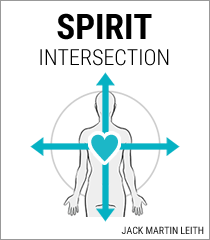
Spirit is represented by the heart, where the horizontal and vertical planes intersect.
To be spirited is to have a force that brings you up, that animates you out of inertia.
Shabaka Hutchings, jazz musician and composer, in The Guardian | View
The heart is where we experience intent as love, specifically as an ever-present desire to be of service and to enrich the world.Spirit is the animating force throughout creation. An unseen force that is life, the divine, the nagual, the light. To live a spiritual life is to identify oneself as the animator of creation, rather than as creation.
Allan Hardman | Visit website
Intent, love and spirit are associated with primal world and sensory experience, whereas labels, definitions and descriptions are abstractions emanating from mundane world.
Faith (“a critical but curious mind’s readiness to adopt a reality model — even if provisionally — for which there is less than absolute, empirical proof” – Jay B. Gaskill, The Dialogic Imperative) is the irreducible precondition for acknowledging, activating and deploying the seven powers.
Read about the imperative of faith and believing without believing
Transcending the mundane
Transcend means to rise above or go beyond the limits of.
It also means to triumph over the negative or restrictive aspects of.
It does not mean to shun.
The Now-to-New wayfarer transcends the mundane by:
Feeling connected to the nonmaterial realm (power of Openness).
Being open-hearted (power of Love).
Feeling connected to the material realm (power of Groundedness).
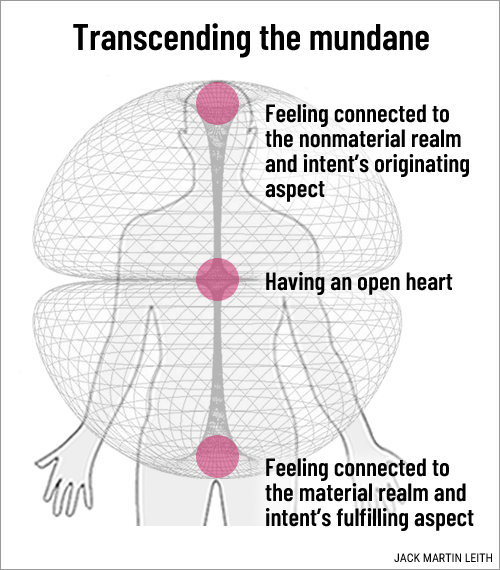
Once we have transcended the mundane, the creative powers of Imagination, Conceptualisation, Materialisation and Realisation (of potential) are fully activated and ready to be deployed.
Mundane world. Primal world.
Synthetic imagination. Natural imagining.
Each has a vital part to play.
Primal world is not the place to be when completing your tax return or shopping for groceries.
Read the article: How might we transcend the mundane and activate natural imagining?
Read more
External sources
Creative Practices Embodied, Embedded, and Enacted in Architectural Settings: Toward an Ecological Model of Creativity by Laura H. Malinin, Director, Nancy Richardson Design Center, Colorado State University, Fort Collins, CO, USA
How Radical Is Embodied Creativity? Implications of 4E Approaches for Creativity Research and Teaching by Laura H. Malinin (as above) | Frontiers in Psychology, 2019; 10: 2372
Embodied Innovation by Tirza Hollenhorst
This website
Iain McGilchrist and his brain lateralisation hypothesis
Jill Bolte Taylor, a neuroscientist who experienced her brain’s left hemisphere shutting down
Synthetic imagination and natural imagining
Search the site
Not case sensitive. Do not to hit return.