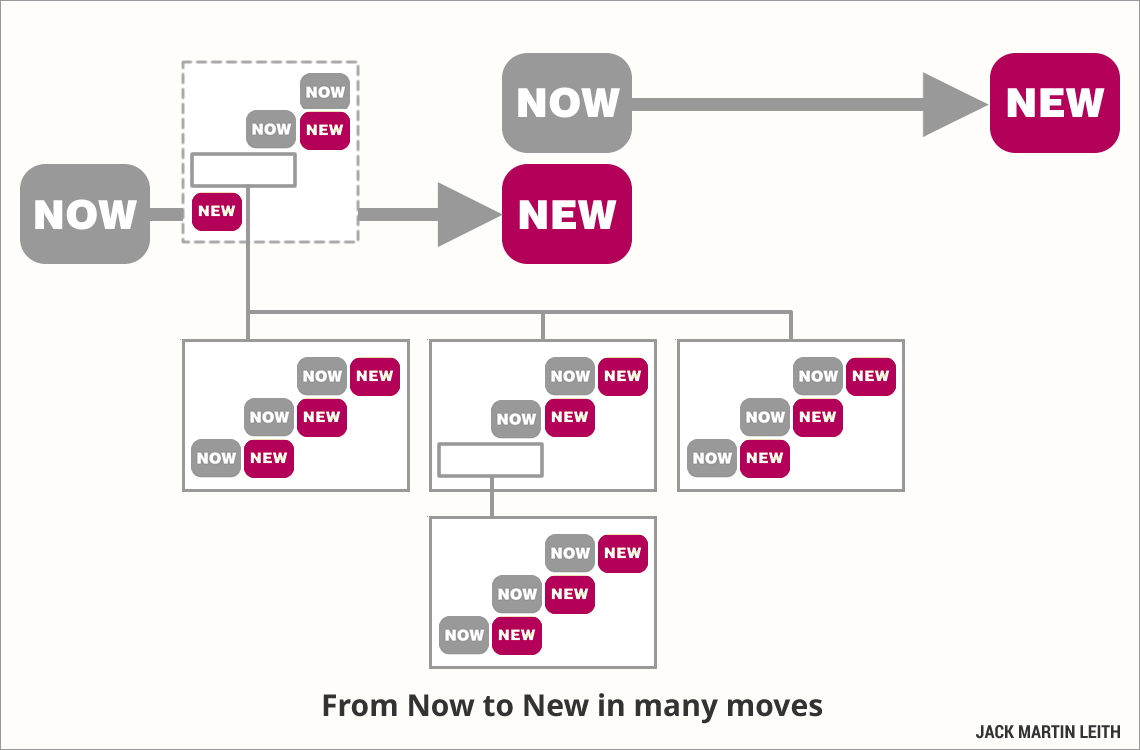
The diagram below illustrates the linear and holonic forms of Now-to-New work and shows how each successive New becomes a new Now.
Why does this matter?
Placeholder text:
Change is not a journey
Change can happen in the moment
The moment of transformation is not an event. It doesn’t have the properties of things or experiences. It has no position, no location in time, no beginning, no middle, and no end. It doesn’t look like anything or feel like anything.
Source: Werner Erhard, Epistemological And Contextual Contributions of est to General Systems Theory, presented to the symposium on Evolving Trends in General Systems Theory and the Future of the Family at the Sixth World Congress of Social Psychiatry, Opatija, Yugoslavia (now Croatia), 5 October 1976
I now pronounce you man and wife
Eighteenth birthday
Switching a light on
Railway points
Typing these words
Now-to-New building blocks, from one jump to multiple jumps to (multiple) nested jumps
NEW is not fixed
Read more
External sources
From Now to New Right Here: Change-as-Flipping. A set of 19 slides created by Niels Pflaeging and Silke Hermann, BetaCodex, based on by my work in part and credited | View slides | Download pdf
This website
Search the site
Not case sensitive. Do not to hit return.