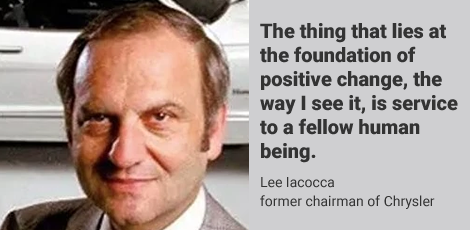
Lee Iacocca was a celebrated CEO of Chrysler Corporation (now FCA US, LLC, doing business as Stellantis North America) during the 1980s
Unconditional vs reciprocal service
Unconditional service is selfless action taken by an individual or group for the benefit of others, motivated by a heartfelt desire to enrich the world.
When we give unconditional service, we work for the benefit of others without wanting anything in return.
In contrast, conditional or reciprocal service is encapsulated in the phrase “you scratch my back and I’ll scratch yours”. If you do a favour for me, I now owe you a favour. There is a debt, and it must be repaid if relations are to remain cordial.
This is not service. It’s trading favours, an unspoken – and sometimes explicit – deal, a quid pro quo arrangement.
‘Paying it forward’ may seem a more enlightened approach, but the word paying exposes its underlying transactional nature.“In professional relationships, I find that most people follow the norm of reciprocity: when we do someone a favor, we expect an equal one back.
In friendships, the norm shifts from reciprocity to generosity. We focus on what our friends need, not what we can get back from them. Instead of keeping tallies of credits and debts, friends give whenever they can.”
Source: You’re Not My Friend, by Adam Grant, a professor at the Wharton School of the University of Pennsylvania, and the author of Give and Take: A Revolutionary Approach to Success.
Coming from the heart, unconditional service is unconditional love made manifest through generative action. It doesn’t make sense to the rational mind, the source of conditional, reciprocal service. But when we provide unconditional service, our faith — “a critical but curious mind’s readiness to adopt a reality model (even if provisionally) for which there is less than absolute, empirical proof” 1 — is vindicated.“Pay it forward is an expression for describing the beneficiary of a good deed repaying it to others instead of to the original benefactor. The concept is old, but the phrase may have been coined by Lily Hardy Hammond in her 1916 book In the Garden of Delight: ‘You don’t pay love back; you pay it forward.’”
Source: Wikipedia—Pay it forward.
1. Jay B. Gaskill, The Dialogic Imperative.
Unconditional love and intent are different names for what is, in essence, the same impulse
Love is the reason. Intent is the means to manifest the reason wholly and energetically. That manifestation is the totality of yourself.
Della Van Hise, The Energetic Marriage of Love & Intent
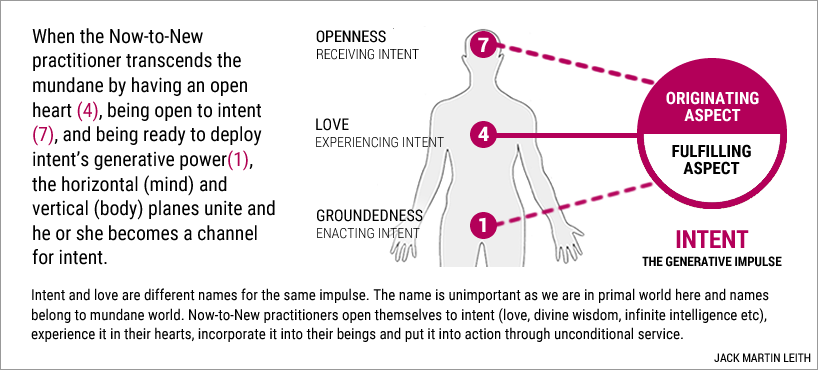
Read about intent, the generative impulse
Sometimes altruism is the wrong call
When I’m at the pub and I buy someone a drink, it’s unconditional and I don’t expect to be bought one in return.
But this is not always wise.
The other person may, for example:
- Be embarrassed.
- Think it’s weird.
- Feel there will be a debt.
- Think I have an ulterior motive.
- Think I’m playing the big shot.
- Feel there’s a power imbalance.
- Be part of a group where people are taking turns to buy a round.
More quotes
“The real joy of daily work is in what we have to give. We are not fulfilled by what we can seek to please us, but what we can build and offer. It is not fame, or money, or recognition that makes for a thoroughly meaningful life, it is how we put our gifts to use. It is how we give.”
Source: You’re Not Meant To Do What You Love. You’re Meant To Do What You’re Good At. By Brianna Wiest, founder of Soul Anatomy.
THE WARRIOR’S LOVE Love has many meanings for warriors; the great unconditional love of warriors is their love of this earth, this world; unconditional love is one of the bridges between the great contradictions of the warriors’ world; the warriors’ conditional feelings of love are part of the boundaries that human feelings create around things of this world; the warriors’ unconditional love grows out of a detachment from the first attention 2 and its agendas.
Source: Tomas, from The Glossary forming part of Creative Victory, a discourse on the collected works of Carlos Castaneda
2. First attention corresponds with the brain’s left hemisphere and mundane world.
Nothing liberates our greatness like the desire to help, the desire to serve.
Marianne Williamson
Brain imaging studies consistently show that acts of genuine generosity – helping a colleague without expectation of return, celebrating a friend’s success without jealousy – activate the striatum, the brain’s deepest reward centre, more powerfully than receiving a benefit yourself. This makes evolutionary sense. Homo sapiens did not survive by being the strongest primate. The Neanderthals held that distinction, and they went extinct. We survived because we built networks of cooperation and mutual aid. Our brains are wired to reward us for extending these networks, and the neurological pleasure of authentic generosity is the mechanism through which it happens. But the brain is precise about the word “authentic”. Help someone [in order] to create an obligation, and the reward response is muted. Help because you actually care, and it amplifies. Lucky people understand this distinction instinctively. They give freely and, in doing so, build the kind of social capital that opens doors they did not even know existed.
Down on your luck? How behavioural neuroscience could help, by Nobuko Nakano on The Guardian website
Sevā (also transcribed as sewa), in Hinduism and Sikhism, is the concept of selfless service that is performed without any expectation of reward for performing it. Such services can be performed to benefit other human beings or society. Sevā means “service”. A more recent interpretation of the word is “dedication to others”. In Hinduism, it is also known as karma yoga, as described in the Bhagavata Gita.
Source: Wikipedia
We die but once, and we die without distinction if we are not willing to die the death of sacrifice. Do you covet honor? You will never get it by serving yourself. Do you covet distinction? You will get it only as the servant of mankind.
Woodrow Wilson, US President from 1913 to 1921 | View a transcript of the address that includes this passage
Tracy Francis One last question. You have worked on products like the iPod and iPhone that completely reinvented a broad set of systems. Are you always reimagining the entire system, challenging its underlying assumptions? Is there a way you think about reimagining whole systems?
Jony Ive I really don’t. I just start with people, and I’m very clear about my place and my contribution. I like this idea that what I do is in service to humanity, to culture, to people. It’s a place I find very comfortable. Our motivation is not only what defines us in terms of our values but also our fuel for what we do. I can’t think of a more profoundly powerful fuel than realizing that what I’m doing is for other people, not for myself.
Jony Ive, former design head of Apple and currently co-founder of LoveFrom, in conversation with McKinsey chief marketing officer Tracy Francis and McKinsey Quarterly editorial director Rick Tetzel | View transcript on McKinsey & Company website
“In professional relationships, I find that most people follow the norm of reciprocity: when we do someone a favor, we expect an equal one back. In friendships, the norm shifts from reciprocity to generosity. We focus on what our friends need, not what we can get back from them. Instead of keeping tallies of credits and debts, friends give whenever they can.”
Adam Grant, You’re Not My Friend. Adam Grant is a professor at the Wharton School of the University of Pennsylvania, and the author of Give and Take: A Revolutionary Approach to Success
Only from the Divine can you receive.
To all others: give!
You will be given all that you need.Dialogue with Lily, 24 September 1943
Talking With Angels | Oral text by Hanna Dallos; transcription and commentary by Gitta Mallasz
Being in service is about evoking creative authority in others, and that means you’re in service to the creative process itself.
Bill Isaacs, leadership advisor
Life’s most persistent and urgent question is: What are you doing for others?
Martin Luther King
I slept and dreamt that life was joy. I awoke and saw that life was service. I acted and behold, service was joy.
Jared Croslow, author and Internet marketer
Read more
External sources
The Energetic Marriage of Love & Intent, by Della Van Hise
Unconditional service, by Steve Curtin
This website
Intent — the generative impulse
Search the site
Not case sensitive. Do not to hit return.