People create the new in order to generate value
Whenever people create something such as a business, product, service, facility, musical composition or website, they do so in order to generate value.The Now-to-New wayfarer recognises four main kinds of value: economic value, conceptual value, functional value and experienced value.
Economic value means money, which comes in the form of revenue and profit for a business, and donations for a charity.
Conceptual value is typically seen in value propositions and purpose statements, or scribbled on Post-it Notes during a workshop session. Examples: Refreshment. Comfort. Safety.
Functional value is the taken for granted value that you only notice by its absence, such as the salt you forget to put in the saucepan along with the potatoes.
Experienced value is not something you can handle, like a £10 note. Nor is it an abstract concept such as refreshment.
Imagine this scenario: It’s a hot day. You are thirsty. You buy a can of beer. You remove the ring-pull and take a swig. Whatever happens next in your sensory system is what I’m calling experienced value (if it’s a positive experience, otherwise you’re experiencing anti-value).
It’s utterly subjective, and cannot be fully expressed through language.
Anti-value is the degenerative counterpart to value
Anti-value is more than dissatisfaction. It manifests as an experience of physical pain or emotional upset arising from a poorly designed or malfunctioning value generator (see below), or from the denial of previously received and possibly taken for granted value. Anti-value generation may be deliberate or unintended.
Although I mostly talk about value and anti-value, there are times when the snappier gains and pains works better.
Create vs generate
An enterprise creates a value generator, which generates value when the beneficiary interacts with it.
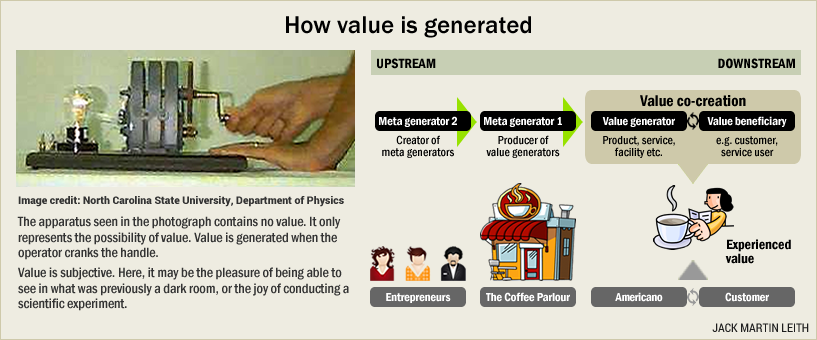
An enterprise cannot create value — it can only create value generators.
How value is generated
Value is not embedded in the value generator (product, service or whatever) and delivered as if by FedEx. It is co-created when the beneficiary (e.g. consumer, user) interacts with it.
Read about beneficiaries, beneficiary groups and beneficiary sets
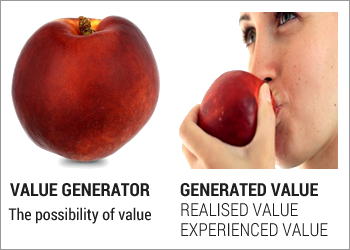
Value generator examples:
- Product
- Service
- Facility such as this website
- Event (conference, music festival)
- Establishment (museum, theatre, restaurant)
- Infrastructure (railway station, railway line)
- Educational programme (course, seminar, workshop)
- Artistic creation (book, song, musical composition, painting, theatrical production)
Maximising ecosystem value
I devised the Ecosystem Value Maximisation tool as a way of determining and appreciating the value requirements of each ecosystem constituent, down to individual level if necessary.
Now-to-New wayfarers seek to maximise ecosystem value for two reasons.
- Enriching the world is their common purpose.
- They subscribe to the hypothesis that when a Now-to-New project meets the value requirements of each constituent, the project will be supported, or — at the very least — its progress will not be hindered.
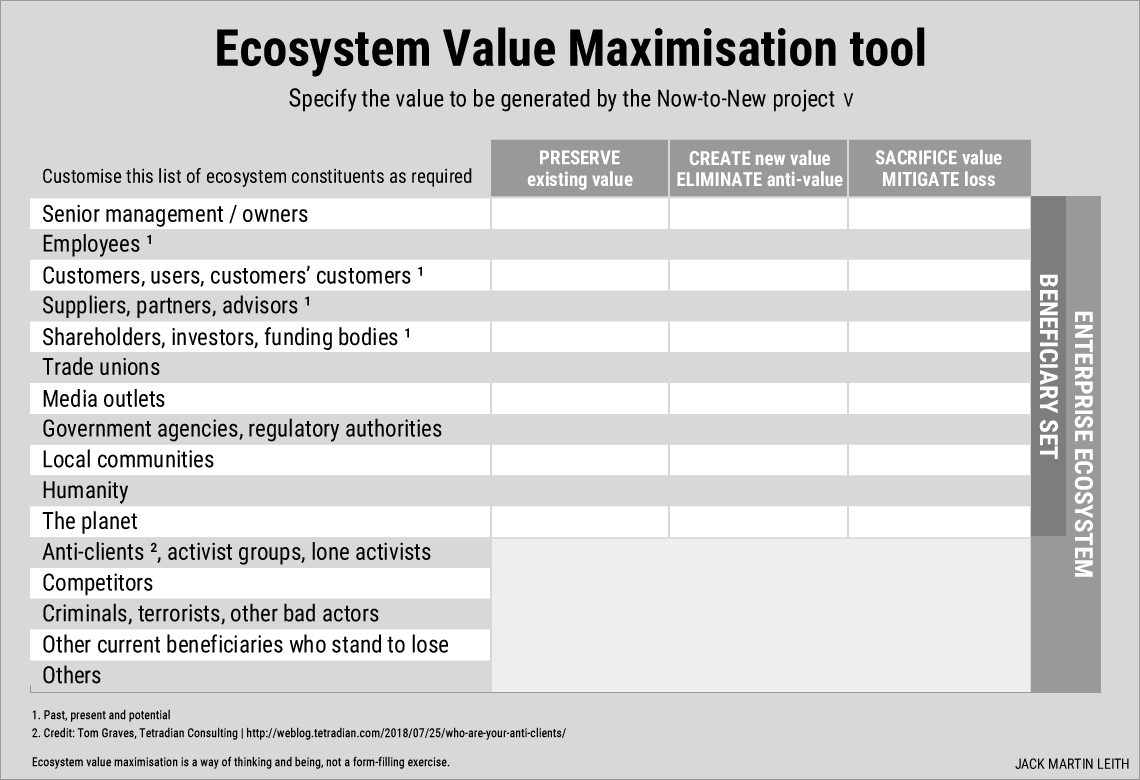
The Ecosystem Value Maximisation tool enables you to consider each ecosystem constituent in turn and determine what new value might be generated, what existing value must be preserved, what anti-value generation must be halted, and what value must be sacrificed for the good of the whole.
New value to be generated
What unmet needs might the new creation satisfy?
Existing value to be preserved
What current value generation must continue? What interests must be protected?
Anti-value generation to be halted
What sources of anti-value generation must be shut down?
Value that must be sacrificed for the good of the whole
When the termination of currently received value cannot be avoided, the resulting anti-value (such as disappointment, anger or grief) must be foreseen and mitigated.
In this context, mitigation means limiting the number of people experiencing anti-value, or minimising the degree of anti-value experienced, or both.
Those suffering the loss of value may need some form of compensation. If nothing else, the loss must be acknowledged and the reasoning explained.
Value maximisation is a way of thinking and a way of being
Seeking to enrich the world is a stand you take in the world. The Ecosystem Value Maximisation tool is really just a checklist to make sure you’ve covered all the bases.
Read more about specifying the value your new creation is intended to generate
Read more
What is value and how is it generated?
Search the site
Not case sensitive. Do not to hit return.