The Now-to-New Capability diagram (view) includes a box labelled Enablers.
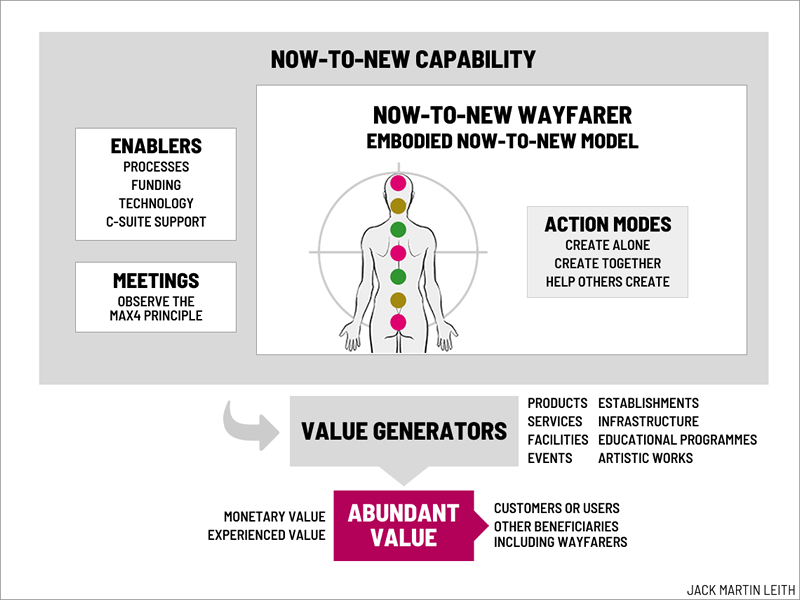
The box contains four items:
- Processes
- Funding
- Technology
- C-suite support
What is a process?
A process is a series of actions producing a result that is invariable within specified limits.
In other words, follow these steps and get these results.
Examples:
- Brushing your teeth.
- Making a cake.
- Doing the laundry.
- Getting cash from an ATM.
- Brewing beer.
So no processes (the word is serving as a proxy), only activities that may need to be resequenced or redesigned in response to emerging events.
These are the four activities I’ll be outlining:
Now-to-New work, from inception to completion.
Ecosystem Value Specification work.
Idea conception and elaboration work.
These are upstream activities. Downstream activities are addressed in the article Examine a typical Now-to-New project from start to finish.
Now-to-New work, from inception to completion
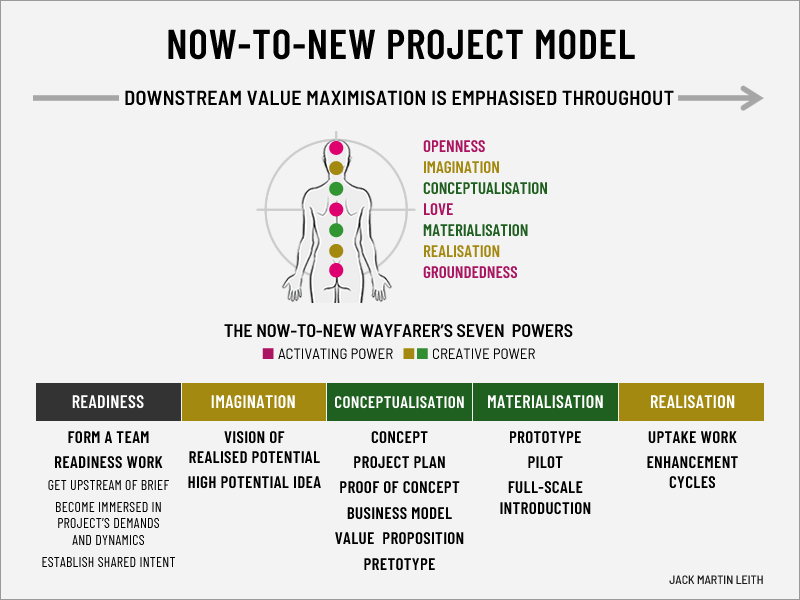
A Now-to-New project starts with a need or desire to bring something new into being, and ends when the value generation potential of the creation has been fully realised.
The activities labelled Imagination, Conceptualisation, Materialisation and Realisation each have a counterpart in the wayfarer’s body, which is the seat (literally or figuratively) of the necessary creative power.
For example, Imagination work — envisioning a tantalising possibility and conceiving a high potential idea for actualising it — calls for the personal power of Imagination. This is associated with the mythical ‘third eye’. Other associations are shown in the table below.
| POWER | TYPE OF POWER | PART OF SUPERPOWER | PURPOSE | ASSOCIATION 1 |
|---|---|---|---|---|
| OPENNESS | Activating | Transcend the Mundane | Connecting to the nonmaterial realm — ‘Heaven’ | Crown |
| IMAGINATION | Creative | Enrich the World | Imagining a world enrichment possibility and a way of actualising it | Third eye 2 |
| CONCEPTUALISATION | Creative | Create the New | Devising something 3 that will generate the imagined value | Throat |
| LOVE | Activating | Transcend the Mundane | Experiencing an ever-present desire to be of service and to enrich the world | Heart |
| MATERIALISATION | Creative | Create the New | Giving the creation 3 tangible form and introducing it to the world at large | Solar plexus 4 |
| REALISATION | Creative | Enrich the World | Bringing the creation to fullness and realising its value generation potential | PC muscles 5 |
| GROUNDEDNESS | Activating | Transcend the Mundane | Connecting to the material realm — ‘Earth’ | Tailbone |
1. This refers to a metaphorical association, not a literal location.
2. The mythical third eye is located between and just above the eyebrows.
3. The new creation might be a product, a service, a facility or some other form of value generator.
4. Situated below the diaphragm and above the navel.
5. The PC (pubococcygeus) muscles are what we use to control urine flow.
In the same way that the map is not the territory, the Now-to-New Project Model is an impoverished representation of actual Now-to-New work undertaken in the real world.But it becomes a much richer representation when integrated with the embodied Now-to-New model.
Read more about the embodied Now-to-New model
Readiness work
Readiness work sets the Now-to-New project in motion.
It primes primes Now-to-New project team members for the conception of a potent and fitting idea by immersing them in the demands and dynamics of the project and evoking a felt sense of the new reality in which the intended value will be experienced by the identified beneficiaries.
Projects don‘t so much go wrong as start wrong.
Bent Flyvbjerg, Villum Kann Rasmussen Professor, IT University of Copenhagen | His book Megaprojects and risk: an anatomy of ambition is considered essential reading for project managers, sponsors and those involved in megaprojects | Bent Flyvbjerg’s Wikipedia entry
Why is it called Readiness work?
It has this name because its fundamental purpose is preparing fertile ground in readiness for the showing up of a tantalising value generation possibility and the conception of a high potential idea — one that is potent and fitting — for bringing the possibility to fruition.
Readiness work is arduous. But it is essential.
Read more about Readiness work
Ecosystem Value Specification work
This is a component of Readiness work.
The Ecosystem Value Specification tool enables you to consider each ecosystem constituent in turn and determine what new value might be generated, what existing value must be preserved, what anti-value generation must be halted, and what value must be sacrificed for the good of the whole.
The underlying hypothesis holds that when a Now-to-New project meets the value requirements of each ecosystem constituent (down to individual level if necessary), the project will be supported, or — at the very least — its progress will not be hindered.

Read more about ecosystem value specification work
Idea conception and elaboration work
The Idea-to-Concept Method can be used by individuals and groups of any size to bring a raw idea across threshold from the realm of thought to the realm of the discussable, where the idea becomes a raw concept and ready for further elaboration.A thought in your head is real as an experience. A draft in a folder is real as an artifact. A feeling is real as a feeling. But if it has not been externalized into a form that another observer can actually encounter, then it is not yet real between observers. It has not yet entered the space where the world pushes back — and the world will push back.
Timothy Solomon, The Boundary Between Private and Shared Reality
Why this method is preferable to brainstorming and its derivatives
- It recognises that an idea is conceived in the imagination of an individual, not in some fanciful group mind.
- Natural imagining and synthetic imagination are integrated.
- All three Now-to-New action modes — creating alone, creating together and helping others create —are deployed.
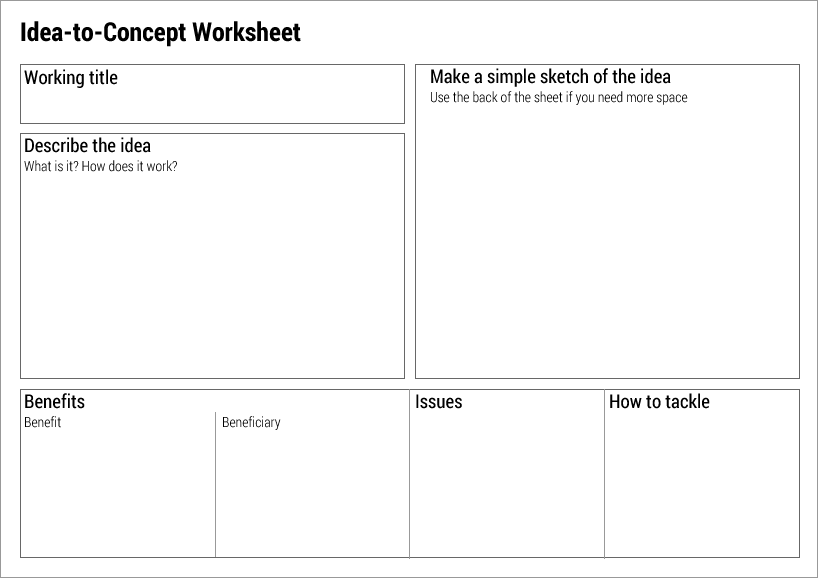
- The Idea-to-Concept Worksheet enables the intangible idea to be made more tangible and makes the idea discussable. This shift from the realm of thought to the realm of the discussable follows a shift of attention from the mythical third eye (between and just above the eyebrows) to the throat.
- Ideas are discussed and enhanced, and ways of addressing shortcomings are explored. In this way, the raw idea starts to become a fully formed concept.
- The Max4 Principle (four is the maximum group size for a proper conversation) is observed.
- The needs of introverts, autistic people, other neurodivergent members of society and the socially anxious are accommodated.
- A single concept emerges: one that is potent and a good fit.
Download Idea-to-Concept Worksheet (pdf)
Find out why I reject brainstorming
Read more
Search the site
Not case sensitive. Do not to hit return.