Index
Briefing Note 1: Be a rigateur

Tap image to view full size.
What is a rigateur?
A rigateur is someone with a fully-formed rig (their natural-born create-the-new capability) who deploys it – either ad hoc or moment by moment – in order to imagine tantalising possibilities, create the new and enrich the world with value, meaning and joy.
This starts with faith – the ability to proceed despite uncertainty.
Go to Briefing Note 9 to read about faith and believing without believing
Reusing and remixing website content
Content I’ve created is licensed under a Creative Commons Attribution-ShareAlike license | CC-BY 4.0 (view deed).
This means you can reuse and remix anything I’ve originated as long as you retain the CC-BY 4.0 license and cite Jack Martin Leith as the originator.
Briefing Note 2: US President Woodrow Wilson

Tap image to view full size.
Woodrow Wilson was an American politician and academic who served as the 28th president of the United States from 1913 to 1921.As president, he changed the nation’s economic policies and led the United States into World War I in 1917.
He was the leading architect of the League of Nations, and his progressive stance on foreign policy came to be known as Wilsonianism.
Read a full transcript of the address he gave at Swarthmore College, Pennsylvania, USA on 25 October 1913.
Contrary to the widely-circulating quote, his actual words were “You are not here merely to prepare to make a living” (he was addressing undergraduates).
View the Wikipedia entry for Woodrow Wilson
Briefing Note 3: Create the new what?

Tap image to view full size.
In their personal lives, rigateurs create the new for the benefit of family members, the local neighbourhood, the wider community and the world at large
A personal create-the-new project might entail, for example, establishing a YouTube channel, launching a campaign for restoring a former railway line, setting up a community radio station, taking steps to revitalise a struggling community, or founding a nonprofit organisation.
Creating the new in the workplace is much harder unless every project team member is a rigateur.
Rigateurs create value generators, which generate value
A value generator is something tangible or intangible that produces experienced value when the user interacts with it.
These are the main types of value generator:
- Products
- Services
- Facilities (this website, for instance)
- Events (conference, party, festival)
- Educational programmes (course, seminar, workshop)
- Establishments (museum, theatre, restaurant)
- Infrastructure (railway station, railway line)
- Artistic works (book, song, musical composition, painting, theatrical production)
The concept of value co-creation comes from service-dominant logic, originated by academics Stephen Vargo and Robert Lusch, who use the word appliance in much the same way as I use value generator.
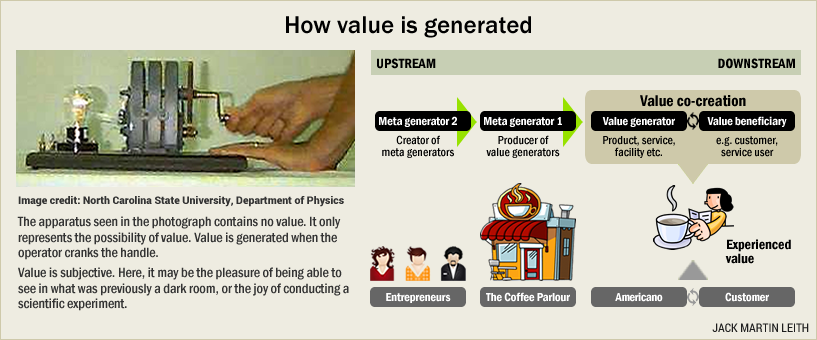
Rigateurs create businesses and nonprofit organisations
Businesses and organisations are examples of what I call a meta generator – a creator of value generators.
Rigateurs create new states of affairs, new realities
The change has happened as intended, or the problematic situation is a thing of the past.
Briefing Note 4: Humans are equipped for creating the new

Tap image to view full size.
John Ernst Steinbeck (1902 – 1968) was an American writer. His books include Cannery Row, East of Eden, Of Mice and Men and The Grapes of Wrath. He won the 1962 Nobel Prize in Literature and has been called “a giant of American letters”. View the Wikipedia entry for John Steinbeck
We divide the Creative Process into pieces in an effort to understand and picture the complexity of the entire process. But let’s not fall into the trap of believing that we actually execute the pieces in some sort of lock step fashion. It’s convenient and instructive to perceive that creativity has certain stages, and that we can all emotionally, physically and mentally relate to these stages, but to hold any model of the creative process as a precise description of creativity, and to force others to adhere strictly to its application is foolish.
Stuart Kauffman uses an expression to describe the difficulty of modeling any living system: “the algorithm is incompressible.” In other words, there’s no shorter method, routine or program to describe life or living systems than life or the living system itself. Models are representations of reality but they are not the reality itself. There is no algorithm or equation that we can force creativity into that is shorter than the creative act itself.
Bryan Coffman when at MG Taylor Corporation, referring to stages in the MG Taylor DesignShop process | View source
Briefing Note 5: The rig

Tap image to view full size.
The rig is a person’s natural-born create-the-new capability.Briefing Note 6: The rigateur’s mind

Briefing Note 7: The rigateur lives with one foot in each world / 1

Tap image to view full size.
See also Briefing Note 24.While the left hemisphere’s raison d’être is to narrow things down to a certainty, the right hemisphere’s is to open them up into possibility. In life we need both. […] We desperately need both in order to reason properly and to use our imagination creatively.
Iain McGilchrist, The Divided Brain and the Making of the Western World, a talk given at Royal Society for Arts | Download transcript (pdf)
Briefing Note 8: Mundane world and primal world

Tap image to view full size.
Mundane world (evoked by brain’s left hemisphere)
Mundane world is the everyday world, a default reality where we spend most of our waking lives. It’s a world of descriptions. If something can be named, described and explained, it’s part of mundane world. Mundane world is the sum total of everything we know and everything the rational mind can imagine. When we’re situated in primal world we experience life in the raw, but in mundane world we experience only a representation of reality, a video we mistake for the live performance.
Primal world (right hemisphere)
Primal world is an indescribable place of pure perception. This world cannot be explained or proved to exist; it can only be experienced. Primal world is raw, visceral, untamed, unfiltered, uncodified and unconceptualised. When we’re immersed in primal world we’re able to activate and deploy natural imagining.
Everything I’ve written about primal world is a grossly impoverished representation of actual blood and guts experience.
Briefing Note 9: Believing without believing

Tap image to view full size.
Sorcerers call the ability to manipulate their mental attachments ‘believing without believing’. They have perfected that art to the point where they can identify sincerely with any idea. They live it, love it, and discard it without remorse if it comes to that.
Carlos Castaneda, cited in Further Conversations with the Nagual (pdf; 117 pages), by Armando Torres
Briefing Note 10: Watching a video vs being part of the performance

Tap image to view full size.
The left hemisphere produces abstraction, mistaking the map for the terrain it represents.Jon Evans How do the left and right hemispheres do things differently?
Iain McGilchrist If you want a very simple, single point, it’s that the left hemisphere produces a representation of reality, whereas the right hemisphere actually puts us in touch with the presence of reality. We’re so used to representation that we can’t see how very different it is. Almost everything that we live in now is a representation, a projection on a screen in two dimensions; living in a city which represents certain things but nature is absent from it. So it’s like the difference between a diagram, a theory, a map, and the actual territory of the real world — or the terrain as I prefer to say — in which we live. And the map is very much simpler than the terrain. And that’s not a criticism, because we need simplicity for a map to work. If it had too much information in it, it wouldn’t work. But it’s vital not to mistake the map for the real world.
Source: The divided brain, attention and how we see the world (timestamp 26:34) — Iain McGilchrist in conversation with Jon Evans (host of YouTube channel Uncensored CMO and Chief Customer Officer at System1 Group) and Orlando Wood (Chief Innovation Officer at System1 Group) | Running time 48:35

© Michael Leunig
Iain McGilchrist references Alfred Korzybski’s well known dictum: The map is not the territory. This is featured in the next slide.See also Briefing Note 16.
Briefing Note 11: The map is not the territory

Tap image to view full size.
“The actual train wouldn’t be quite as fast as that.”
Mistaking the map for the territory is a logical fallacy that occurs when someone confuses the semantics of a term with what it represents. Polish-American scientist and philosopher Alfred Korzybski remarked that “the map is not the territory” and that “the word is not the thing”, encapsulating his view that an abstraction derived from something, or a reaction to it, is not the thing itself. Korzybski held that many people do confuse maps with territories, that is, confuse conceptual models of reality with reality itself.
The relationship has also been expressed in other terms, such as “the model is not the data”, “all models are wrong”, and Alan Watts’s “The menu is not the meal.” A frequent coda to “all models are wrong” is that “all models are wrong (but some are useful),” which emphasizes the proper framing of recognizing map–territory differences—that is, how and why they are important, what to do about them, and how to live with them properly. The point is not that all maps are useless; rather, the point is simply to maintain critical thinking about the discrepancies: whether or not they are either negligible or significant in each context, how to reduce them, and so on.
Excerpted from Wikipedia – Map–territory relation
We divide the Creative Process into pieces in an effort to understand and picture the complexity of the entire process. But let’s not fall into the trap of believing that we actually execute the pieces in some sort of lock step fashion. It’s convenient and instructive to perceive that creativity has certain stages, and that we can all emotionally, physically and mentally relate to these stages, but to hold any model of the creative process as a precise description of creativity, and to force others to adhere strictly to its application is foolish.
Bryan Coffman when at MG Taylor Corporation, referring to stages in the MG Taylor DesignShop process | View source
We say the map is different from the territory. But what is the territory? Operationally, somebody went out with a retina or a measuring stick and made representations which were then put on paper. What is on the paper map is a representation of what was in the retinal representation of the man who made the map. The territory never gets in at all. Always, the process of representation will filter it out so that the mental world is only maps of maps, ad infinitum.
Gregory Bateson, Steps to an Ecology of Mind
Briefing Note 12: Seeing an isolated tree in detail vs the seeing the whole forest in context

Tap image to view full size.
Some left hemisphere characteristics
- Attention is local, narrow, focused.
- Sees parts, not wholes.
- Sees an inanimate world of things.
- Thinking is decontextualized and systematic.
Corresponding right hemisphere characteristics
- Attention is global, broad, vigilant, flexible, sustained.
- Sees the bigger picture.
- Sees things whole.
- Sees things in their context.
There are no things in primal world.
No names. No descriptions.
No distinctions. No this, that, me, you.
No context, no environment.
No systems, whole or otherwise.
It is important to maintain the awareness that the systems view itself is also just another map that, as Alfred Korzybski put it, should not be confused with the territory. We can reduce the world to a whole just as easily as we can reduce it to a collection of parts.
Daniel Christian Wahl, [6 Key Questions in] Whole Systems Thinking, an excerpt from this book, Designing Regenerative Cultures
Briefing Note 13: Thinking vs noticing thoughts

Tap image to view full size.
Thought was never intended to grasp the ultimate nature of reality; it evolved to solve problems relevant to human survival and everyday life.
Harish Josev, The Thing About ‘Thing-in-Itself’, based on Hans Vaihangar | view source

Explore further
The Galvanising Gift of Noticing Thoughts
Briefing Note 14: Planning vs spontaneity

Tap image to view full size.
When undertaking a create-the-new project, a detailed plan is not required.Everyone has a plan until they get punched in the mouth.
Mike Tyson
You only need to think about the big stepping stones and what needs to happen next.
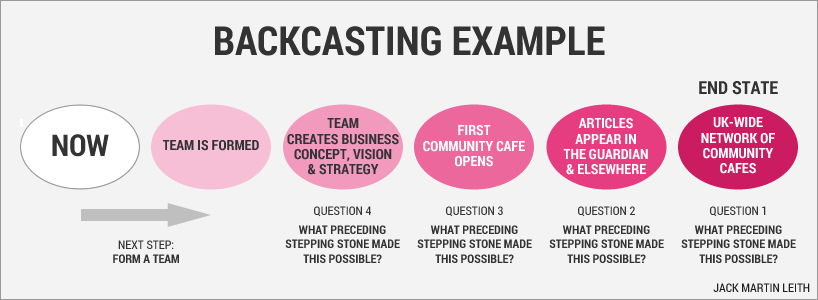
The ground will shift as the project progresses.
Unforeseen obstacles and opportunities will almost certainly arise.
This is when spontaneous action might be the right response.
The purpose of the plan is to help you get to the next plan.We live in a world that underestimates the unexpected and prizes linear thinking and the illusion of control. But life, as well as business, is more emergent than that, as the global pandemic and Black Lives Matter protests have shown. We plan things in one way, and something else happens. Some people leverage that sort of change into positive outcomes and others don’t. In my research into what makes individuals and organizations fit for the future, one insight has come up again and again: It turns out that many of the world’s leading minds have, often unconsciously, developed a capacity to cope with the unexpected. This ability, which I call a serendipity mindset, allows for the unexpected to be viewed as an opportunity rather than a threat.
Christian Busch, a business professor at University of Southern California’s Marshall School of Business, cited by Suvarchala Narayanan in her strategy+business article Connecting the dots in an uncertain world
Briefing Note 15: Names, descriptions and the arrow of time

Tap image to view full size.
Things, names and descriptions
The left hemisphere sees things, names them, describes them.
The right hemisphere sees an undivided whole where all is intimately connected. No things, no names, no descriptions.
This is covered in Briefing Note 12.
The arrow of time
We divide time into three parts — past, present and future. That division is false, absolutely false. Time is really past and future. The present is not part of time. The present is part of eternity. That which has passed is time; that which is to come is time. That which is, is not time, because it never passes — it is always here. The now is always here — it is always here! This now is eternal.
Osho (Bhagwan Shree Rajneesh), in Tantra Spirituality and Sex
Don Juan tells us that eternity is all around us, and that any given moment can become eternity if we use it to take the totality of ourselves forever in any direction. Accepting the responsibility for finding our way to the impossibility of such a moment is the essence of the warrior’s way of being.
Source: Tomas, Creative Victory
In primal world there is no time. Instead, there is the eternal now.The moment of transformation is not an event. It doesn’t have the properties of things or experiences. It has no position, no location in time, no beginning, no middle, and no end. It doesn’t look like anything or feel like anything.
Source: Werner Erhard, Epistemological And Contextual Contributions of est to General Systems Theory, presented to the symposium on Evolving Trends in General Systems Theory and the Future of the Family at the Sixth World Congress of Social Psychiatry, Opatija, Yugoslavia (now Croatia), 5 October 1976
Between the end of one moment and the beginning of the next, nothing ‘exists’, and the truly new comes from nothing.
Briefing Note 16: The pitfalls of abstraction and reification

Tap image to view full size.
Abstraction
Abstraction as process
Abstraction simplifies complex things by focusing on the most important aspects while ignoring details.
What we do: Simplify and generalise.
Example: Making a map of the London Underground system.
Abstraction as product
An abstraction is something that exists only as an idea. A construct.
“An imperfectly defined explanatory notion” – Gregory Bateson, Steps to an Ecology of Mind.
What results: The conceptual or symbolic outcome.
Example: The map itself or the idea of a system.
The aim of science is to seek the simplest explanations of complex facts. We are apt to fall into the error of thinking that the facts are simple because simplicity is the goal of our quest. The guiding motto in the life of every natural philosopher should be, seek simplicity and distrust it.
Alfred North Whitehead, mathematician and philosopher
See also Briefing Note 10.It is important to maintain the awareness that the systems view itself is also just another map that, as Alfred Korzybski put it, should not be confused with the territory. We can reduce the world to a whole just as easily as we can reduce it to a collection of parts.
Daniel Christian Wahl, [6 Key Questions in] Whole Systems Thinking, an excerpt from this book, Designing Regenerative Cultures
Reification
Reification is the act of treating an abstract noun as a concrete thing that can be created, acquired, altered, improved, managed or otherwise manipulated.
Alfred North Whitehead called it The Fallacy of Misplaced Concreteness.
In assigning fixed labels we commit the fallacy of misplaced concreteness. According to Whitehead, by mistaking abstractions, beliefs or mental constructs for physical or “concrete” reality, we hypnotise ourselves.
Larry G. Maguire, The Fallacy of Misplaced Concreteness
Reification (also known as concretism, hypostatization, or the fallacy of misplaced concreteness) is a fallacy of ambiguity, when an abstraction (abstract belief or hypothetical construct) is treated as if it were a concrete real event or physical entity. In other words, it is the error of treating something that is not concrete, such as an idea, as a concrete thing. A common case of reification is the confusion of a model with reality: “the map is not the territory”.
Source: Wikipedia entry for Reification (fallacy)
The idea of a separate self in Western cultures is just one result of this phenomenon. It is ironic that all of us have to communicate via symbols. Ironic also that concepts such as “purpose” and “soul” as well as “ego” are symbolic abstractions that do not exist outside of language and our agreed upon definitions. Yet we treat them almost always as if they were palpable, real things. We could choose to remain silent in the face of this paradox or to speak out and laugh at our dilemma while remaining conscious of the trap of speaking.
Susanne Cook-Greuter, The Construct-Aware Stage of Ego Development and its Relationship to the Fool Archetype (pdf) in Integral Review, August 2018. Vol. 14, No.1
Some no-things that cannot be created or manipulated
 Mindset
Culture
Problem
Relationship
Change
Communication
Belief
Trust
Creativity
Engagement
Growth
Behaviour
Justice
Peace
Values
Explore further
Abstract nouns are seductive but dangerous, by Valerie Iles
Beware the abstract noun, on the Vernacular website
The Paradox of Immersion and Abstraction (download) by Chris Rodgers,
Briefing Note 17: Constraints to generative thought and action

Tap image to view full size.
Orthodoxies, norms, conventions, dogmas, narratives and ideologies
These are part of a larger set of factors that impede generative thought and action.
Some items, dogmas for instance, can simply be disregarded once you’ve recognised them.Generative
Geared towards generating value. Seeking to create that which improves people’s lives and makes the world a better place. There are two main levels of generative action. Level 1 is action aimed at generating value for others (lend someone your bike). Level 2 is action aimed at creating that which generates value for others, again and again (give them your bike, or start a nonprofit that lends out bikes).
Certain other items must be observed if you’re to avoid undesirable consequences.
Eliminating such constraints can require ingenuity and resourcefulness.
Morality, respect and accordance with the law must govern your intentions and actions.
Remember: the rigateur seeks not only to generate value, but also to avoid the generation of anti-value.
Enrich the world. Do not impoverish it.
The mundane world trap
The first attention 2 basically consists of everything that ordinary man considers it means to be human. It is the reality that has been constructed and developed in order to deal with the daily world and encompasses an awareness restricted to the physical body.
Lorraine Marie | Website
2. First attention corresponds with mundane world.
Power is at the heart of this world, not because the world is evil but because marshaling energy to make a better reality takes power. What I’m talking about here is unlimited in terms of space and time. This is not some little parochial dark power a fool uses to provoke fear. This is not a pond. This is the ocean. This is the big one. This is what is at the core of the individual. It is not neutral, it is not empty, it is not a system, it is not technical. It is electric and alive. To put it another way, it is what you find inside the nut when you crack open the shell. You find the kernel. It says, ‘When you tap me, I give you energy, as much as you want.’ However, for this to happen, the decks need to be cleared of certain obstructions. Certain roadblocks need to be pushed out of the way. This can be done.
Source: Jon Rappoport
Jim Channon, 1979

“One way of describing the process of enlightenment … is popping out of the structure and into the spirit. If you can’t travel freely into either set then your [sic] stuck in the cultural trance.” Download First Earth Battalion Operations Manual by Jim Channon, Lt Col US Army | Download is safe and screen display is fine but some pdf pages do not render correctly
Jack Martin Leith, 2025
I created this image while unaware of Jim Channon’s model.

Here, mundane reality is analogous to Seahaven, the false world inhabited by Truman Burbank, Jim Carrey’s character in The Truman Show.

Seahaven
The movie industry has shown us other false worlds such as the Land of Oz in The Wizard of Oz and blue pill reality in The Matrix trilogy.Explore further
A tale of norms and laws by Koen Smets on Substack
Overruling rules by Koen Smets on Substack
Briefing Note 18: Shun domestication and separation from nature

Tap image to view full size.
Do not be afraid to bare your teeth – you were not brought into this world covered in blood to become a gentle, tamed thing.
Helen Ingram posting on X (view)
To the eyes of the man of imagination, nature is imagination itself.
William Blake
Nature connectedness is a psychological concept that measures the closeness of an individual’s relationship with other species. Studies have found that people with higher levels of nature connectedness enjoy improved wellbeing and are more likely to act in environmentally friendly ways. Low levels of nature connectedness have been identified as one of three major underlying causes of biodiversity loss alongside inequality and the prioritisation of individual, material gains.
“There’s ways we can rethink the way we do business – bringing nature into decision-making, nature in the boardroom, and biodiversity net gain. They can start to shift the system, where nature isn’t just simply treated as a resource but as a stakeholder.” – Miles Richardson, professor of human factors and nature connectedness at University of Derby
Britain one of least ‘nature-connected’ nations in world – with Nepal the most by Patrick Barkham on The Guardian website
People are capable of being very creative but only seem to tap into their potential when there is a major earthquake or something. But if people were more conscious of our place within nature, stopped abusing the Earth and put things back into it, we would have a healthier environment and society. Art is the spiritual equivalent of that purification, which is passed to us as energy – and all artists have to draw on that.
Jack DeJohnette, excerpted from Jack DeJohnette was more than a jazz drummer – his staggering range made him a superhuman force in music, by Philip Clark on The Guardian website
What if instead of taming people, we trained them to be more skillful at being wild?
Euvie Ivanova, co-founder of Future Thinkers, pictured here with co-founder Mike Gilliland

The major problems in the world are the result of the difference between how nature works and the way people think.
Briefing Note 19: Life is not a story

Tap image to view full size.
Viewing your life as a story may make it more meaningful, but it will also close off possibilities.Further, dark episodes from bygone chapters could prevent you from taking generative action in the present.
And they may keep joy from your life.
If there were no constraints, anything could happen at any moment.
As I type these words, my boiler might explode or a letter could arrive with news of a tax rebate.
Each moment is a separate event but your left hemisphere, left to its own devices, will join the dots in an attempt to make sense of things.
And whatever sense you make of it is another story.
Explore further
Your life is not a story: why narrative thinking holds you back, by Karen Simecek, associate professor of philosophy at University of Warwick
I am not a story, by analytic philosopher and literary critic Galen Strawson
Briefing Note 20: Reciprocal vs unconditional service

Tap image to view full size.
Unconditional service is selfless action taken by an individual or group for the benefit of others, motivated by a heartfelt desire to enrich the world.When we give unconditional service, we work for the benefit of others without wanting anything in return.
In contrast, conditional or reciprocal service is encapsulated in the phrase “you scratch my back and I’ll scratch yours”. If you do a favour for me, I now owe you a favour. There is a debt, and it must be repaid if relations are to remain cordial.
This is not service. It’s trading favours, an unspoken – and sometimes explicit – deal, a quid pro quo arrangement.
Unconditional service comes from the heart. It doesn’t make sense to the rational mind, the source of conditional, reciprocal service. But when we practice unconditional service in faith, we find that real-world feedback and in-the-body experience let us know we are making the right choice.In professional relationships, I find that most people follow the norm of reciprocity: when we do someone a favor, we expect an equal one back.
In friendships, the norm shifts from reciprocity to generosity. We focus on what our friends need, not what we can get back from them. Instead of keeping tallies of credits and debts, friends give whenever they can.
Source: You’re Not My Friend, by Adam Grant, a professor at the Wharton School of the University of Pennsylvania, and the author of Give and Take: A Revolutionary Approach to Success.
‘Paying it forward’ may seem a more enlightened approach, but the word paying exposes its underlying transactional nature.
Pay it forward is an expression for describing the beneficiary of a good deed repaying it to others instead of to the original benefactor. The concept is old, but the phrase may have been coined by Lily Hardy Hammond in her 1916 book In the Garden of Delight: “You don’t pay love back; you pay it forward”.
Source: Wikipedia—Pay it forward.
Sometimes altruism is the wrong call
When I’m at the pub and I buy someone a drink, it’s unconditional and I don’t expect to be bought one in return.
But this is not always wise.
The other person may, for example:
- Be embarrassed.
- Think it’s weird.
- Feel there will be a debt.
- Think I have an ulterior motive.
- Think I’m playing the big shot.
- Feel there’s a power imbalance.
- Be part of a group where people are taking turns to buy a round.
More quotes
The real joy of daily work is in what we have to give. We are not fulfilled by what we can seek to please us, but what we can build and offer. It is not fame, or money, or recognition that makes for a thoroughly meaningful life, it is how we put our gifts to use. It is how we give.
Source: You’re Not Meant To Do What You Love. You’re Meant To Do What You’re Good At. By Brianna Wiest, founder of Soul Anatomy.
Nothing liberates our greatness like the desire to help, the desire to serve.
Marianne Williamson
Brain imaging studies consistently show that acts of genuine generosity – helping a colleague without expectation of return, celebrating a friend’s success without jealousy – activate the striatum, the brain’s deepest reward centre, more powerfully than receiving a benefit yourself. This makes evolutionary sense. Homo sapiens did not survive by being the strongest primate. The Neanderthals held that distinction, and they went extinct. We survived because we built networks of cooperation and mutual aid. Our brains are wired to reward us for extending these networks, and the neurological pleasure of authentic generosity is the mechanism through which it happens. But the brain is precise about the word “authentic”. Help someone [in order] to create an obligation, and the reward response is muted. Help because you actually care, and it amplifies. Lucky people understand this distinction instinctively. They give freely and, in doing so, build the kind of social capital that opens doors they did not even know existed.
Down on your luck? How behavioural neuroscience could help, by Nobuko Nakano on The Guardian website
Briefing Note 21: Seeking certainty vs being OK with not knowing

Tap image to view full size.
Certainty
Certainty is the state of being free from doubt or having no questions about something.
The realm of certainty is the realm of scientific method, evidence and proof.
Certainty can refer to a state of mind, such as having a strong belief or confidence in something, or to a scenario that is very likely to happen or is impossible to doubt.
We need to sit with uncertainty, not run from it. Acknowledging with confidence and courage that lack of knowledge is what drives our curiosity, uncovering new understanding. Our craving for certainty often makes us ignore what is important, those small doubts that whisper: maybe we can’t cut costs further, perhaps the drugs don’t work, is the building safe? If, by letting go of our craving for certainty, we retrieve a sense of our capacity to make something – of ourselves, of each other, of the world – we can discover the benefits of doubt.
Margaret Heffernan, Embrace the unknown: the benefits of learning to live with uncertainty, on The Guardian website
Don’t be careful. You could hurt yourself.
Louise Bourgeois
How to escape left-brain thinking
Iain McGilchrist in conversation with Freddie Sayers, executive editor of UnHerd
Running time 1:06:38
But I’m also not interested in the end in whether it is true in that way or not, because for me mythos is a much bigger truth than logos ever could be. The facts of the case are the icing on the cake, but the cake is there anyway.
Iain McGilchrist | Start at 9:40 for the part that includes this excerpt
Knowing and not knowing
Between full ignorance and total certainty is a vast intermediate space where we conduct our lives.
Carlo Rovelli, Italian theoretical physicist
Being able to not know, for the poet John Keats (and the psychoanalyst Wilfred Bion who quoted him), means being “capable of being in uncertainties, mysteries, doubts, without any irritable reaching after fact and reason”. It gives rise to a state of mind in which your thoughts can wander and wonder, you can be curious, have feelings, and out of those feelings can grow thoughts, and you can dream and test out ideas and explore.
Moya Sarner, Want to know everything? Perhaps it’s best if you don’t on The Guardian website
Faith
Faith is the ability to proceed despite uncertainty.
Faith, of the kind described in the quotes below, is the overriding prerequisite for transcending the mundane and creating that which enriches the world.
Faith is a much-abused term, often derided in modern secular circles as the blind obedience to some arbitrary authority. But it has a wiser and more useful meaning: faith as a critical but curious mind’s readiness to adopt a reality model (even if provisionally) for which there is less than absolute, empirical proof. I propose that this kind of faith is the necessary adaptation by any rational mind to the challenges of life in the real world in which reality presents us with far too much, far too quickly. Events, personalities and relationships that carry embedded meaning and value are not the sorts of existents that can pass any rigid absolute-empirical-proof test.
All trust relationships contain a measure of faith. So when the term faith is used in this essay [The Dialogic Imperative], it refers to reasonable faith, as in the faith that is necessary for a reasonable mind to operate in the real world. Faith in this sense requires courage. Reasonable faith is heuristic in the sense that it is only by means of growing trust that we can open ourselves to the full range of knowledge that the universe presents to us.
There is a faith path from Isaac Newton through Baruch Spinoza to Albert Einstein that has propelled the scientific enterprise: Each of these great minds was moved by the faith-based conviction that the universe has been endowed with an elegant underlying deign, so miraculously intelligible to human intelligence that scientists are justified in doggedly pursuing its secrets.
Jay B. Gaskill, The Dialogic Imperative (download pdf)
Faith represents an existential commitment of the heart, a way of life, a set of behaviors and emotional responses woven into every hour of everyday life — expressed through constant choices both when alone and in social situations.
Peter A. Georgescu, Faith isn’t irrational, but beliefs may be, on Huffington Post website | Peter A. Georgescu is Chairman Emeritus at advertising agency network Young & Rubicam, Inc.
Everything is faith, including faith in science. The extent that science can reduce the world into objective certainties is absurdly limited, and most of human life and experience will always remain faith-based.
Benedict Waterson, commenting on the UnHerd article Shroud of Turin shows that science only enhances mystery, by Esme Partridge
More quotes
Ego development theory proposes that it is a characteristic of maturity to discover that not knowing is the highest form of knowing. Foo-ling is about the capacity to recognize the folly of trying to explain and map everything. It is about truly seeing how thoroughly we tend to confuse our maps and theories with the territory.
Susanne Cook-Greuter, The Construct-Aware Stage of Ego Development and its Relationship to the Fool Archetype (pdf)
The reason every wisdom tradition, from Taoism to modern neuroscience, identifies uncertainty tolerance as the fundamental skill is that uncertainty is the essential nature of existence itself — it’s the gap between cause and effect where all possibility lives.
When the Buddha spoke of impermanence as the source of suffering, when quantum physics revealed the probabilistic nature of reality, when entrepreneurs discover that markets are fundamentally unpredictable, they’re all pointing to the same truth: control is an illusion, and the attempt to grasp certainty in an uncertain universe creates the very suffering we’re trying to avoid.
The religious mind calls this faith, the entrepreneurial mind calls it courage, the neuroscientific mind calls it prefrontal cortex regulation of the amygdala – but they’re all describing the capacity to function powerfully while acknowledging you don’t know and can’t control what happens next.
Every breakthrough in human history happened because someone moved forward without knowing the outcome, while everyone else waited for certainty that never came.
This isn’t about conquering fear; it’s about recognizing that uncertainty is reality’s baseline state, and your resistance to it – not the uncertainty itself – is what creates paralysis.
Developing this capaciy requires understanding that you can’t think your way into comfort with uncertainty; you must feel your way through it.
The practice is deceptively simple: notice when you’re avoiding small uncertainties – compulsively checking your phone, over-preparing for minor conversations, seeking reassurance – and instead pause to feel the discomfort in your body without trying to resolve it.
Start with manageable doses: have a conversation where you don’t plan what you’ll say next, start a project before you feel ready, take a different route without checking the map first.
Each time you function successfully despite feeling uncertain, you’re building empirical evidence against your brain’s catastrophic predictions.
This is what ancient Stoics meant by voluntary discomfort, what exposure therapy leverages, what entrepreneurs call “getting comfortable being uncomfortable” – the deliberate, repeated experience of feeling anxious while nothing terrible happens, gradually teaching your nervous system that uncertainty is not danger.
The transformation occurs through accumulation: after hundreds of repetitions of “I felt uncertain, I continued anyway, I survived and often thrived,” your brain reclassifies uncertainty from “existential threat” to “normal operating condition.”
Source unknown
If there were already a logical answer, we would have already found it.
Now this isn’t the Middle Ages.
There isn’t a shortage of people who are desperately trying to look logical to each other.
You can call them McKinsey.
You can call them your board of directors.
You can call them a finance department.
You can call them your procurement department.
Rational people are all over the sodding place, and they control everything.
Therefore if a problem is persistent it’s fairly likely, I would suggest, that the reason for the persistence of that problem is that it’s logicproof.
There may be a solution to it, but conventional linear rationality isn’t going to find it.
Rory Sutherland, Vice-chairman, Ogilvy | View source
Explore further
The certainty of ignorance by Koen Smets on Substack
The certainty of uncertainty by Max St John
Briefing Note 22: Denial of intent vs visceral experience of its presence

Tap image to view full size.
Denying the existence of intent
This is the rational thing to do.
Intent cannot be proven to exist.
Experiencing the presence of intent
Intent is an aspect of primal world, where there are no things, no its, no names, no descriptions.
We have to call it something, otherwise we can’t talk about it.
Intent is nothing more than a code word, a placeholder term.
We also need a working definition, even though we know it’s an invention.
Here is my current version, which is ever open to revision:
And this is what I mean by generative — a term that, sadly, has been hijacked by the AI industry:Intent
The generative impulse concerned with creating the new and bringing it to fullness.
It is impossible to prove that the existence of the generative impulse I call intent, because it does not inhabit the realm in which proof operates. It non-exists in primal world, the non-realm of nonexistence.Generative
Geared towards generating value. Seeking to create that which improves people’s lives and makes the world a better place. There are two main levels of generative action. Level 1 is action aimed at generating value for others (lend someone your bike). Level 2 is action aimed at creating that which generates value for others, again and again (give them your bike, or start a nonprofit that lends out bikes).
If intent (spirit, source, the Tao etc.) is real, then surely there would be some kind of device that indicates its presence?
There is such a device.
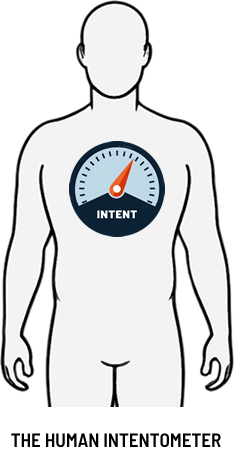
Intent is experienced as a heartfelt desire to be of service and to enrich the world or a particular piece of it.
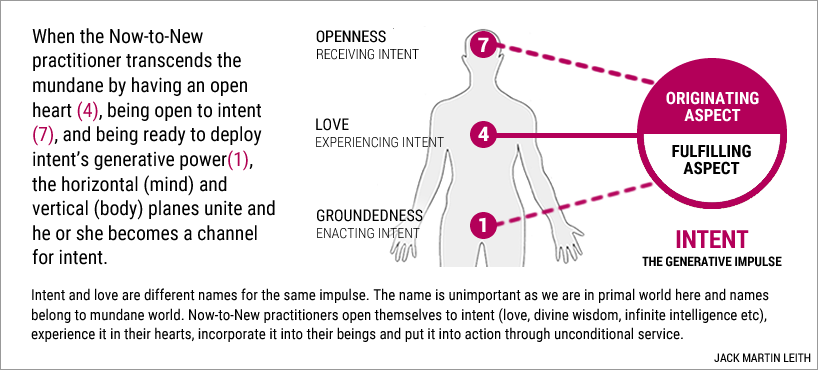
Intent and natural imagining are associated with primal world.
When we transcend the mundane, enter primal world and embrace intent (this is really a single activity), natural imagining is awakened and we are able to harness intent’s generative power, working in partnership with ‘ it ’.
In the passages below, Creative Action and Infinite Intelligence are synonymous with intent.
We can learn to link with a stream of Creative Action so fully that it seems that all we think and do originates from within ourselves, rather than from the eternal realm. This degree of rapport and unification with Creative Action is exhilarating and deeply satisfying.
Edward Matchett, industrial design teacher and Creative Action author
Through the faculty of creative imagination, the finite mind of man has direct communication with Infinite Intelligence. It is the faculty through which ‘hunches’ and ‘inspirations’ are received. It is by this faculty that all basic, or new ideas are handed over to man.
Napoleon Hill in his 1937 bestseller Think and Grow Rich!
Explore further
Songwriters, authors etc. talk about a mysterious force that assists them
Briefing Note 23: Synthetic imagination vs natural imagining

Tap image to view full size.
Rigateurs deploy either synthetic imagination or natural imagining as befits the situation.
In his classic 1937 book Think and Grow Rich (download pdf of entire book), Napoleon Hill contrasts synthetic imagination with creative imagination.
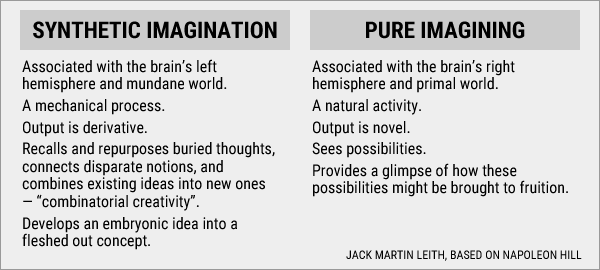
In place of creative imagination I’ve adopted the term natural imagining for the following reasons:SYNTHETIC IMAGINATION: Through the faculty of synthetic imagination, one may arrange old concepts, ideas, or plans into new combinations1. This faculty creates nothing. It merely works with the material of experience, education, and observation with which it is fed. It is the faculty used most by the inventor, with the exception of he who draws upon the creative imagination, when he cannot solve his problem through synthetic imagination.
CREATIVE IMAGINATION: Through the faculty of creative imagination, the finite mind of man has direct communication with Infinite Intelligence2. It is the faculty through which ‘hunches’ and ‘inspirations’ are received. It is by this faculty that all basic, or new ideas are handed over to man.
1. Today, this is known as combinatorial creativity.
2. Infinite Intelligence is also known as spirit, source, intent and the Tao, and by various other names (read more about Infinite Intelligence and the synonyms). But the name is irrelevant: “The Tao that can be told is not the eternal Tao” – Tao Te Ching.
- Both forms of imagination could be considered creative.
- The contrast with synthetic imagination is stronger.
- Imagination is an abstract noun, a no-thing, whereas imagining is a verb, an activity.
- Natural imagining points towards a co-creative partnership with intent (aka Infinite Intelligence, Creative Action etc. — view list of synonyms and related terms).
Synthetic imagination
When people are in mundane world they regard imagination as a tool to be deployed: “I’m going to use my imagination.”
In the workplace, ideas are produced by means of structured idea generation methods, commonly a version of Osborn-style brainstorming using Post-it Notes.
Participants in a choreographed brainstorming session recall and repurpose buried thoughts, connect disparate notions and combine existing ideas into new ones — an approach known as combinatorial creativity.
The facilitator will sometimes introduce SCAMPER or another tool to stimulate the production of a wider range of suggestions.
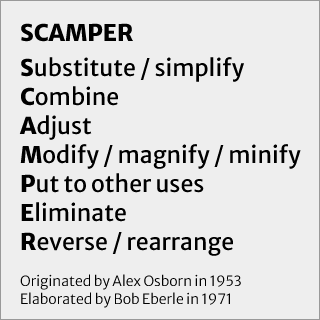
Producing ideas in this way is mechanical and labour intensive, and the ideas produced are likely to be mediocre and derivative.
When engaged in a create-the-new project, synthetic imagination can be employed expediently to flesh out a potent but rudimentary idea brought forth by natural imagining.
Natural imagining
Natural imagining is a verb, referring to an activity in which the rigateur forms a co-creative partnership with intent.Natural imagining refers to a mental state of creative or imaginative thought that is separate from sensory experience and belief. It can be understood in several ways: as a cognitive process that is not grounded in present reality or sensory input as it is when a person mentally constructs a new idea; as a state of pure, unfettered creativity; or as a spiritual or philosophical concept that equates a person’s imagination with a divine source of creation.
Excerpted from a ChatGPT summary
Natural imagining is an organic, uncontrived activity yielding a value generation possibility and a glimpse of how it might be actualised. The raw idea then becomes a rudimentary concept that can be shared with others, further developed, and assessed for desirability, feasibility and viability.We can learn to link with a stream of Creative Action so fully that it seems that all we think and do originates from within ourselves, rather than from the eternal realm. This degree of rapport and unification with Creative Action is exhilarating and deeply satisfying.
Edward Matchett, industrial design teacher and Creative Action author
Possibilities are imagined in the present tense, with the rigateur seeing a parallel reality in which value is being generated for a particular piece of the world in a particular way — right here, right now.
Summary
Briefing Note 24: the rigateur lives with one foot in each world / 2

Tap image to view full size.
Reprising Briefing Note 7.
In the following excerpt, the tonal corresponds with the brain’s left hemisphere and mundane world, while the nagual corresponds with the right hemisphere and primal world.
[don Juan Matus] “I’m afraid you do not understand. I have named the tonal and the nagual as a true pair. That is all I have done.”The brain’s left hemisphere brings forth mundane world and the right hemisphere brings forth primal world.He reminded me [Carlos Castaneda] that once, while trying to explain to him my insistence on meaning, I had discussed the idea that children might not be capable of comprehending the difference between “father” and “mother” until they were quite developed in terms of handling meaning, and that they would perhaps believe that it might be that “father” wears pants and “mother” skirts, or other differences dealing with hairstyle, or size of body, or items of clothing.
“We certainly do the same thing with the two parts of us,” he said. “We sense that there is another side to us. But when we try to pin down that other side the tonal gets hold of the baton, and as a director it is quite petty and jealous. It dazzles us with its cunningness and forces us to obliterate the slightest inkling of the other part of the true pair, the nagual“.
Source: Tales of Power, by Carlos Castaneda | Download extended excerpt that includes this text
The hemispheres are connected by the corpus callosum.
Psychatrist, neuroscience researcher and author Iain McGilchrist reports that in a growing number of people this bundle of nerves is not facilitating the connection as it should.
Of even greater concern is that in some cases the corpus callosum is actually inhibiting the right-left connection.My thesis is that for us as human beings there are two fundamentally opposed realities, two different modes of experience; that each is of ultimate importance in bringing about the recognisably human world; and that their difference is rooted in the bihemispheric structure of the brain. It follows that the hemispheres need to co-operate, but I believe they are in fact involved in a sort of power struggle, and that this explains many aspects of contemporary Western culture.
Iain McGilchrist, The Master and His Emissary
Briefing Note 25: The rigateur’s body

Briefing Note 26: The rigateur’s seven powers / 1

Briefing Note 27: The rigateur’s seven powers / 2

Tap image to view full size.
See Briefing Note 26.Briefing Note 28: The rigateur’s three superpowers

Tap image to view full size.
See Briefing Note 26.Briefing Note 29: The rigateur’s spirit

Briefing Note 30: Spirit is the animating force throughout creation

Tap image to view full size.
We can learn to link with a stream of Creative Action 3 so fully that it seems that all we think and do originates from within ourselves, rather than from the eternal realm. This degree of rapport and unification with Creative Action is exhilarating and deeply satisfying.
Edward Matchett, industrial design teacher and Creative Action author
Although we can’t tell Intent 3 what to do, Toltecs do invoke it and use it. I know that this seems to be a contradiction in terms. But since we are all part of the one universal life, if our purpose is the same as the purpose of the Infinite, then our command becomes the command of the Infinite. When this happens, we can align with Intent and utilize it in creating our life.
Sheri Rosenthal, Intent versus Intention; is there a difference? (no longer available — contact me for more information)
3. Each of these terms is a placeholder for the generative impulse that streams from the unmanifest into the manifest through the gap in time | View list of synonyms and related termsThrough the faculty of creative imagination, the finite mind of man has direct communication with Infinite Intelligence 3. It is the faculty through which ‘hunches’ and ‘inspirations’ are received. It is by this faculty that all basic, or new ideas are handed over to man.
Napoleon Hill in his 1937 bestseller Think and Grow Rich!
See also Briefing Note 22.
Briefing Note 31: Your heart unites your body and your mind

Tap image to view full size.
Mind-body-spirit is nothing more than a convenient fiction. Each one of us is an undivided whole, and the abstracted parts work together in ways we will never fully understand.“Kokoro is well understood in Japanese, but difficult to explain in English,” says Yoshikawa Sakiko, director of Kyoto University’s Kokoro Research Center. Conceptually, it unites the notions of heart, mind, and spirit: It sees these three elements as being indivisible from one other. One of the problems of discussing kokoro in English is that by linking words—heart and spirit and mind—with “and,” we imply divisions that simply don’t exist in Japanese. But in this Eastern culture, the three aren’t intrinsically linked as one: They are one.
This Japanese word connecting mind, body, and spirit is also driving scientific discovery, by Ephrat Livni on Quartz website
Briefing Note 32: Faith is paramount / 1

Tap image to view full size.
Briefing Note 33: Faith is paramount / 2

Tap image to view full size.
Briefing Note 34: The rig in action

Tap image to view full size.
A create-the-new project starts with a desire or need to bring something new into being and ends when the value generation potential of the creation has been fully realised.The ‘something’ could be tangible, such as a physical product of some kind, or an intangible service, or a facility such as this website, or a new reality that’s preferable to the current one, or something else altogether.
Throughout the course of the project, attention is focused on the value that will be experienced by the various beneficiaries when the fully-formed creation is introduced to the world.
Briefing Note 35: Credits

Tap image to view full size.
Iain McGilchrist
Dr Iain McGilchrist is a British psychiatrist, neuroscientist, philosopher and literary scholar who came to prominence after the publication of his book The Master and His Emissary: The Divided Brain and the Making of the Western World in October 2009. His latest book, The Matter with Things: Our Brains, Our Delusions, and the Unmaking of the World, was published in November 2021. In September 2025 he was appointed Chancellor of Ralston College, located in Savannah, Georgia, USA.
McGilchrist is best known for his work on how the brain’s hemispheres differ in the way they attend to the world, and how each hemisphere contributes in its own way to perception, thought and behaviour. Some commentators use the term brain lateralisation hypothesis when referencing McGilchrist’s work, and this is the description I use throughout the website. McGilchrist’s hypothesis supersedes the debunked yet still prevalent split-brain theory developed in the 1960s by Roger Sperry and others.
Read more about Iain McGilchrist on Channel McGilchrist
Jill Bolte Taylor
Dr Jill Bolte Taylor is a Harvard-trained and published neuroscientist (specifically, a neuroanatomist). In 1996 she experienced a severe haemorrhage in the left hemisphere of her brain, causing her to lose the ability to walk, talk, read, write, or recall any of her life. Considering her stroke a blessing and a revelation, she is now a compelling voice for how we can choose to replace our stress, fear and anxiety with feelings of joy and deep inner peace.
Read more about Jill Bolte Taylor on Wikipedia
Edward Matchett
Edward ‘Ted’ Matchett (1929–1998) was a pioneer in the field of industrial design and in the wider create-th-new arena.
He started out as a design engineer at Rolls-Royce — aircraft engines, not automobiles — in Derby, UK, later becoming a teacher of design.
In the 1960s, Matchett was a member of the Coombe Springs community that studied the esoteric teachings of John G. Bennett, based on the work of G. I. Gurdjieff.
From 1966 to 1970, he conducted an investigation into the creative process, sponsored by the Science Research Council of Great Britain. The aim of this research was to identify practical and workable means of injecting a new order of “creativeness, professionalism and achievement” into product design and development.
Matchett established his company Matchett Training and Consultancy Services in 1970 “to take people to the highest level of professionalism and original thinking”, and to do this in a systematic way. His work was usually carried out on the client’s premises and often in a carefully constructed environment he called a “logosphere of meaning”.
Some consider his 5M formulation — Media plus Matter Made Meaningful in the Moment — a work of genius on a par with Einstein’s E = MC2.
Matchett authored six books, three of which you can order from Systematic Innovation:
- Creative Action: The Making of Meaning in a Complex World (first published in 1975)
- Fundamental Design Method
- The Road to True Professionalism
- The Core of True Genius (1996)
- Journeys of Nothing in the Land of Everything | Published by Turnstone books (1975)
- The Sophiagenic Discipline (1997)
Carlos Castaneda
César Arana (later known as Carlos Castaneda) was a Peruvian-American author and anthropologist born on 25 December 1925 in Cajamarca, Peru. He is best known for his influential books that explore shamanism, particularly his apprenticeship with a Yaqui Indian named don Juan Matus. Castaneda died in Los Angeles, California on 27 April 1998. View source
His PhD was heavily criticised. There were allegations of plagiarism and fabrication, and some anthropologists called for it to be revoked, but UCLA did not strip him of the degree and continues to treat him as a regular PhD graduate.
Talking with Angels
Talking with Angels is a collection of esoteric oral teachings voiced by Hanna Dallos in Hungary during the Second World War and transcribed by Gitta Mallasz.
Talking with Angels is the true story of four young Hungarians in search of inner meaning at a time of outer upheaval, the holocaust. In the darkest hours of World War II, these friends, three of them Jewish, seek orientation and meaning in their shattered lives. During seventeen perilous months, one of them, Hanna Dallos, delivers oral messages which Gitta Mallasz and Lili Strausz record in their notebooks. These teachings end abruptly with the deportation of Hanna and Lili to Ravensbrück in December of 1944. Only Gitta Mallasz survived to bring their story and these remarkable dialogues to the world. She always rejected any notion of authorship for this book, saying, ‘I am merely the scribe of the Angels.’”
Based on text found on the Daimon Verlag website, where you can order a copy of Talking with Angels.
Gitta Mallasz (June 21, 1907 – May 25, 1992, pictured, with brother Ottomár in first photo), who transcribed the Angels’ teachings voiced by Hanna Dallos.

Napoleon Hill
Oliver Napoleon Hill (1883 – 1970) was an American self-help author who is best known for his book Think and Grow Rich (1937), which is among the best-selling self-help books of all time. The text of Think and Grow Rich! is founded on Hill’s earlier work The Law of Success (1925 — download pdf), the result of more than twenty years of research based on Hill’s close association with a large number of individuals who achieved great wealth during their lifetimes including the industrialist and philanthropist Andrew Carnegie. In Think and Grow Rich!, Napoleon Hill writes about a faculty he calls synthetic imagination, whereby existing ideas are combined to create a new one. (Today, this approach is called combinatorial creativity.) He contrasts synthetic imagination with creative imagination, through which truly original ideas are conceived.
Dwnload a pdf copy Download pdf of Think and Grow Rich!
You can also download the book as an editable Word document here, courtesy of Doug Keesler.
The chakra system
A chakra is a meditation aid in the form of a psychic or psychospiritual energy centre in the subtle body, as visualised in a variety of Hindu and Buddhist tantric yoga and meditation practices. Esoteric traditions in Hinduism mention numerous numbers and arrangements of chakras.
I reinterpreted the chakras as a set of seven powers.
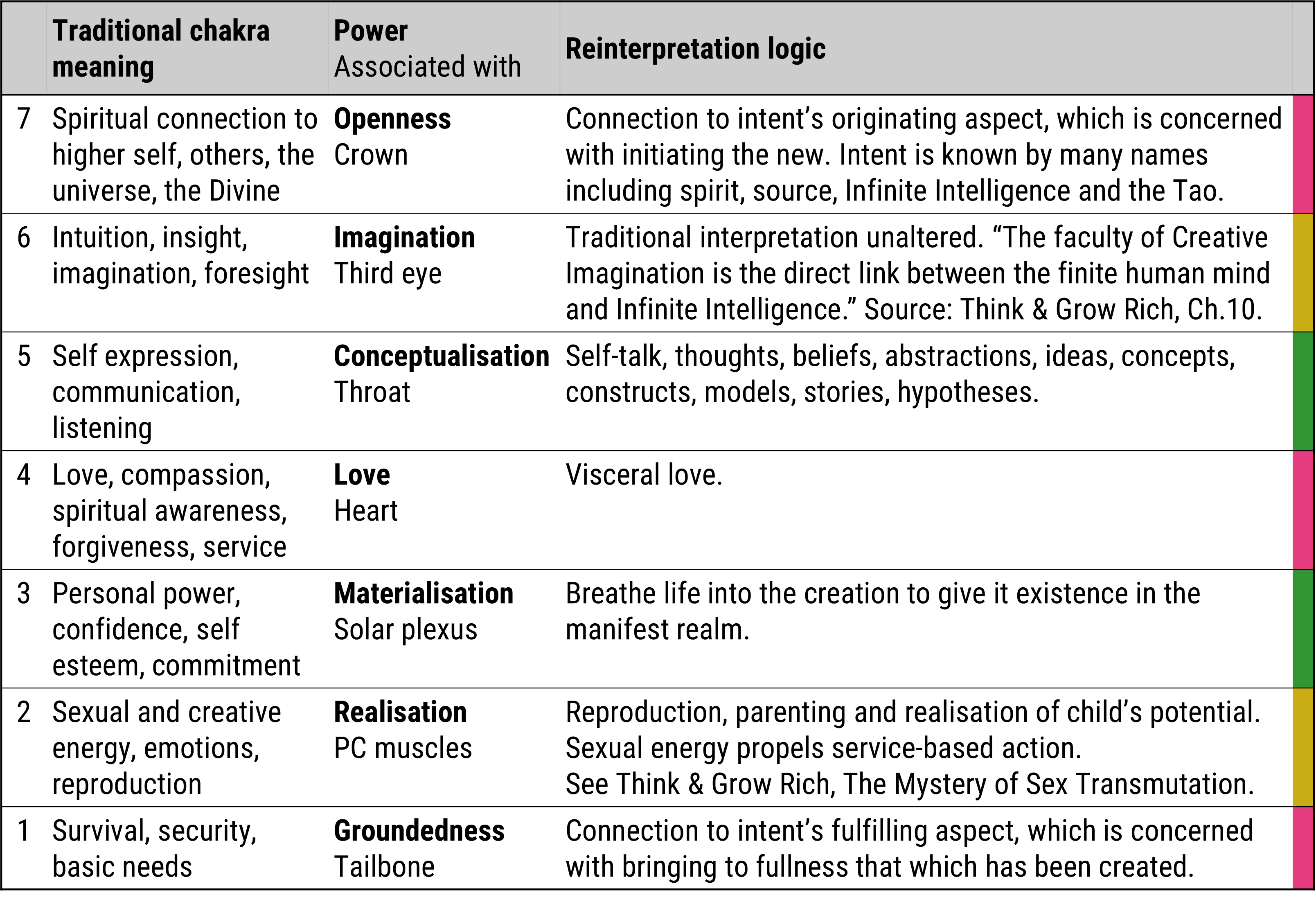
I carried out the work required to fully understand the function of each power over the course of several years, consulting multiple sources (including Talking with Angels), engaging in much deliberation and producing many iterations before settling on the labels and descriptions appearing in the table below.
| POWER | TYPE OF POWER | PART OF SUPERPOWER | PURPOSE | ASSOCIATION 1 |
|---|---|---|---|---|
| OPENNESS | Activating | Transcend the Mundane | Connecting to the nonmaterial realm — ‘Heaven’ | Crown |
| IMAGINATION | Creative | Enrich the World | Imagining a world enrichment possibility and a way of actualising it | Third eye 2 |
| CONCEPTUALISATION | Creative | Create the New | Devising something 3 that will generate the imagined value | Throat |
| LOVE | Activating | Transcend the Mundane | Experiencing an ever-present desire to be of service and to enrich the world | Heart |
| MATERIALISATION | Creative | Create the New | Giving the creation 3 tangible form and introducing it to the world at large | Solar plexus 4 |
| REALISATION | Creative | Enrich the World | Bringing the creation to fullness and realising its value generation potential | PC muscles 5 |
| GROUNDEDNESS | Activating | Transcend the Mundane | Connecting to the material realm — ‘Earth’ | Tailbone |
1. This refers to a metaphorical association, not a literal location.
2. The mythical third eye is located between and just above the eyebrows.
3. The new creation might be a product, a service, a facility or some other form of value generator.
4. Situated below the diaphragm and above the navel.
5. The PC (pubococcygeus) muscles are what we use to control urine flow.
Do chakras really exist?I neither know nor care, and treat the chakra system as a useful metaphor.
Briefing Note 36: Final slide

Tap image to view full size.
Website content created by Jack Martin Leith is licensed under a Creative Commons Attribution-ShareAlike license | CC-BY 4.0 (view deed).This means you can reuse and remix anything Jack has originated as long as you retain the CC-BY 4.0 licence and cite Jack Martin Leith as the originator.
If you have any observations, suggestions or questions you can send me a contact form message.