In this article, creators can mean members of a corporate innovation team, a group of startup founders, or those embarking on a business or nonprofit venture on their own.
Great whole-of-project work
The creators’ pursuit of world enrichment is unrelenting
The creators seek to banish mediocrity, create the great and enrich the world, or a particular piece of it, with value, meaning and joy.
Their primary concern is the value the various beneficiaries will eventually experience.
The value generator being created is the means by which this will be accomplished, making it an important but secondary consideration.
The creators create a value generator – some ‘thing’ that generates downstream value
A value generator is something tangible or intangible that produces experienced value when the user interacts with it, such as a product, service, facility (this website, for instance), event (conference, party, festival), establishment (museum, theatre, restaurant), or artistic work (book, song, musical composition, painting, theatrical production).
The concept of value co-creation was popularised by the academics Stephen Vargo and Robert Lusch, who use the term appliance in the same way that I use value generator.
Explore further:
Beneficiaries, beneficiary groups and beneficiary sets
What is value and how is it generated?
The individual is the primary instrument for creating the new
Innovation models are crude representations of the actual work of conceiving something new and bringing it to fruition.Our species is the only creative species, and it has only one creative instrument, the individual mind and spirit of man.
John Steinbeck, East of Eden, cited by Roger S Bacon in The Myth of the Myth of the Lone Genius
If we want our model to resemble the real world more closely, we need a corresponding one that we have internalised.
The image below depicts the greatcreator’s embodied model incorporating mind (horizontal plane), body (vertical plane), and spirit, with which we connect by means of the Openness–Love–Groundedness triad.
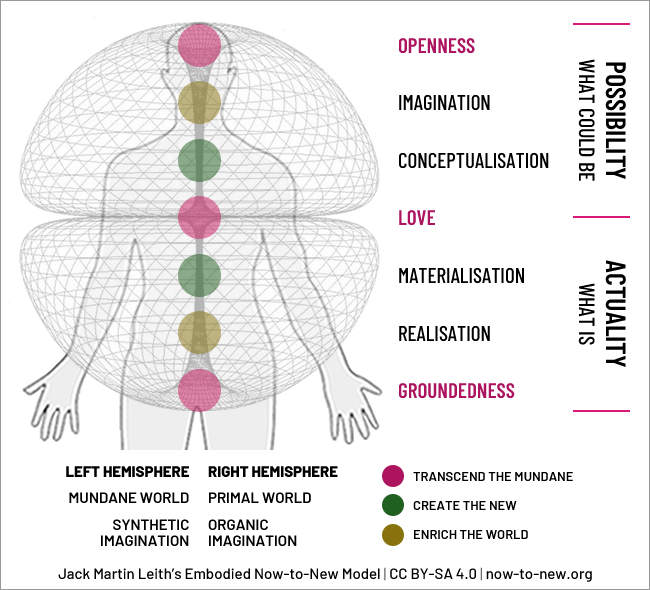
Dual torus image sourced from Michael C Grasso (explore further) and decoloured
Explore futher:The greatcreator’s embodied Now-to-New model
The creators are guided by the Now-to-New project map
Now-to-New is a term I came up with in the early 1990s to denote a shift from the current situation (Now) to what’s need instead (New).
Over the years it has evolved from an umbrella term for innovation, change and problem solving work into a comprehensive approach incorporating insights gained from my lifelong inquiry into how the new comes into being and how this changes into that, beyond prevailing theories and methods.
I road tested the various iterations of the Now-to-New approach over the course of three decades spent as an innovation, change and problem solving consultant. My clients included global corporates, European, national and local government bodies, social enterprises, arts organisations, charities, startups, and consulting firms – both boutique and top tier.
The Now-to-New approach is encapsulated in the project map appearing below.
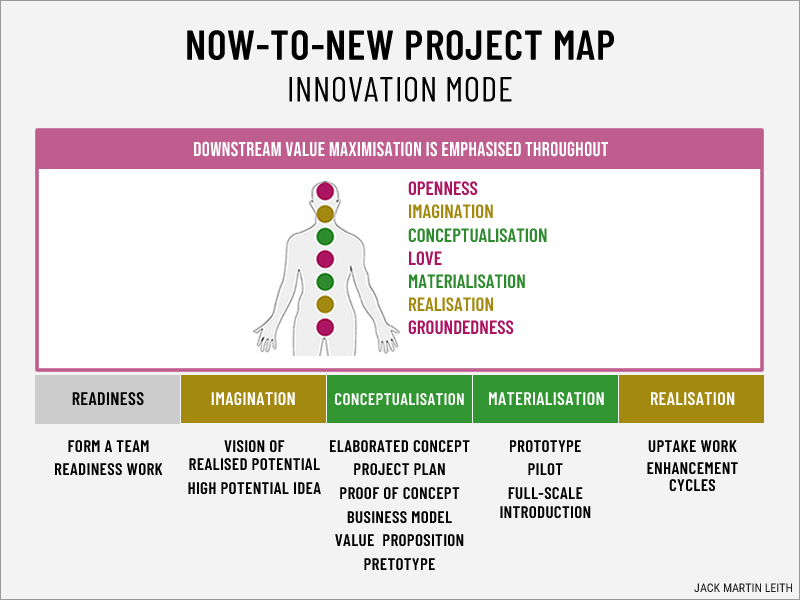
View the change and problem solving version of the project map
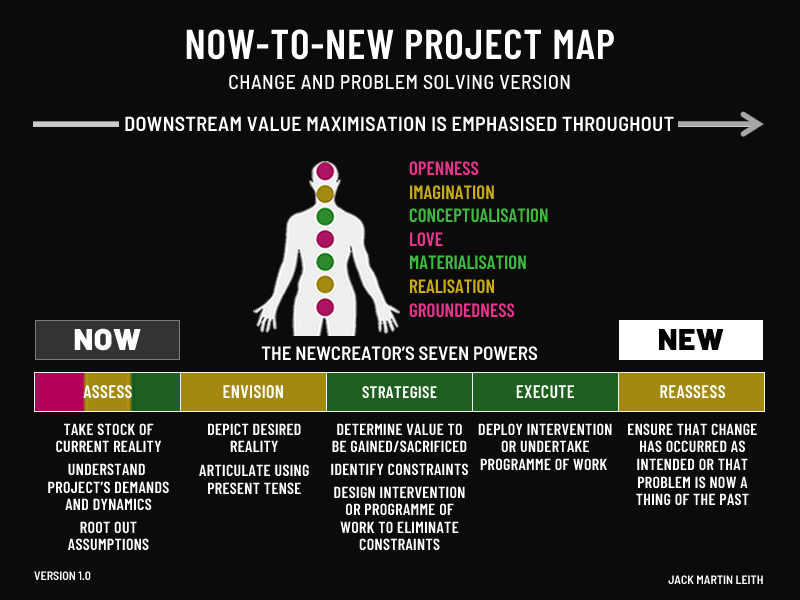
Explore further:
The evolution of the Now-to-New project map
How the term Now-to-New came into being
Now-to-New: a brief introduction
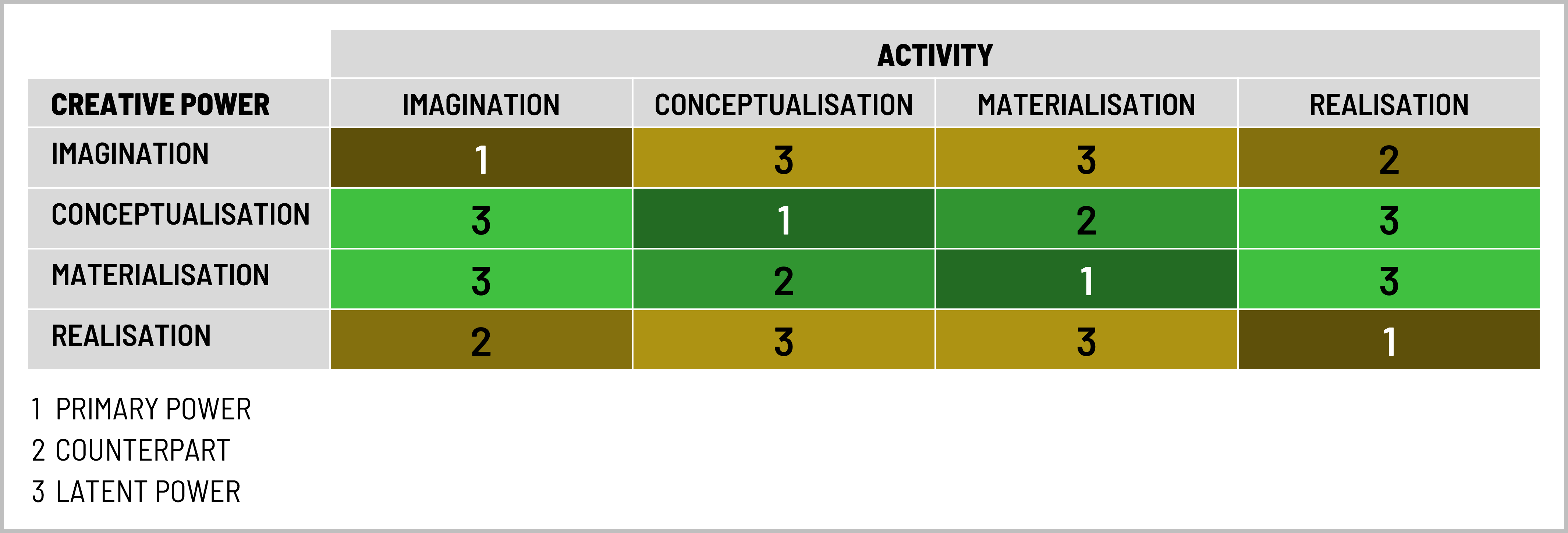
Each creative power corresponds with a chunk of Now-to-New work
The creators use both brain hemispheres, each in accordance with the demands of the particular situation
Insights gained from the writings of Iain McGilchrist, Jill Bolte Taylor, Carlos Castaneda and Napoleon Hill helped me translate left and right hemisphere attributes into realities I named mundane world and primal world.
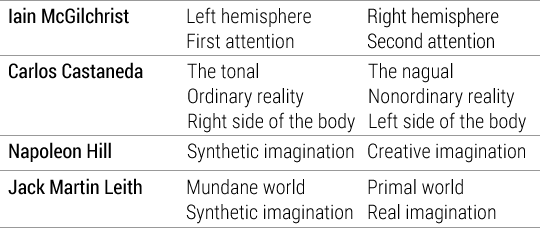
The creators live with one foot in mundane world and the other in primal world.
At any given moment, one foot will be ahead of the other.
The left hemisphere governs the right side of the body and the right hemisphere governs the left side. So left foot forward is right hemisphere forward, literally (read more).
Mundane world is the everyday world, a default reality where we spend most of our waking lives. It’s a world of descriptions. If something can be named and described, it’s part of mundane world. Mundane world is the sum total of everything we know and everything the rational mind can imagine. Here, we experience only a representation of reality, a video we mistake for the live performance.
Primal world is an indescribable place of pure perception. This world cannot be explained or proved to exist; it can only be experienced. Primal world is raw reality, visceral, untamed, unfiltered, uncodified and unconceptualised. When we’re immersed in primal world we’re able to activate and deploy natural imagining.
What is required is a synthesis of both intuition and imagination with reason: the imagined place — though one that is nonetheless with discipline achievable — where each is at its best, standing in equitable relation to each of the others, and informed, where relevant, by science.
Iain McGilchrist, The Matter with Things
Dr Iain McGilchrist is psychiatrist, neuroscience researcher, philosopher, and author of The Master and His Emissary, subtitled The Divided Brain and the Making of the Western World. His latest book is The Matter with Things. Read more about Iain McGilchrist
Iain McGilchrist’s works present the thesis that the two hemispheres of the brain have radically different modes of interacting with the world, and that their respective perceptions and functions must be properly integrated for a viable way forward.
Ruth E. Kastner, The Quantum Master and its Classical Emissary
| LEFT HEMISPHERE | RIGHT HEMISPHERE |
|---|---|
| We seek power and control | We attune to the flow of life |
| We close down to certainty | We open up to possibility |
| We view the world as a collection of inanimate parts | We view the world as a living whole |
| We experience a representation of reality, mistaking the map for the actual terrain | We experience the world as it is, unfiltered and uncodified |
| Our attention is local, narrow, focused | Our attention is global, broad, vigilant, flexible, sustained |
| Our thinking is decontextualized | Our thinking is contextualized |
| Our thinking helps us manipulate the world | Our thinking helps us understand the world |
| We perceive static things | We perceive all in motion |
| We live in the body, rather as we drive a car | We live the body |
To learn more about the two worlds and their significance for greatcreators, view the slideshow (pdf) and accompanying briefing notes (webpage).
The creators believe without believing
Believing without believing means holding a new or existing belief lightly, testing its efficacy in the real world, deciding whether to adopt it, remaining unattached, and discarding the belief when it no longer serves you.
Do not believe in the Divine! Live the Divine!
The Angels | Talking with Angels
Explore further:Choosing to believe or not believe in anything wholeheartedly is a question of faith.
T. Bone, commenting on the UnHerd arfticle The trouble with political Christianity by Alex O’Connor
The imperative of faith and believing without believing
Pure perception — what it is, why it matters and how to attain it
Three Now-to-New action modes are deployed
Fruitful Now-to-New projects require a judicious blend of three action modes:
- Creating alone.
- Creating together.
- Helping others create, in a role such as facilitator, coach or thinking partner.
This is not so. Many authors, songwriters, composers and graphic designers create the new without any input from a collaborator (although they may be co-creating with ‘intent’ – see examples). This website is all my own work, from writing the words and making the graphics to handling all the technical WordPress stuff. I am creating alone at this very moment.
My article The three Now-to-New action modes: Part 2 concludes with this summary:Groups where conformity suppresses the generation of ideas have a tendency to produce, at best, barely adequate solutions, and, at worst, poor and predictable solutions. The best method is for each member of the group to spend significant time alone working on ideas, and for the group to assemble to discuss ideas these individuals have developed.
Royal Military Academy Sandhurst, Occasional Paper No.6—An Officer and a Problem Solver (via Ed Brimmer)
When creating alone
- Remember the Jacopo da Pontormo story.
- Bring in a coach to support you in your solo work.
- Form a team to help you mature your concept, bring it to life and realise its value generation potential.
- Adopt practices (example) that enable people to work alone, in pairs and in groups.
- Know how to combine the three Now-to-New action modes.
- Bring in a coach or a facilitator to support the collaborative work.
- Make sure you are equally strong in all three enablement modes: hand over, join in, and hold the floor.
- Become adept at moving fluidly between enablement modes.
- Maintain vigilance to avoid slipping into the degenerative forms of the modes.
The Myth of the Myth of the Lone Genius by Roger S Bacon
The three Now-to-New action modes: Part 2
An extended project team is formed, with clear, consistent project ownership and leadership
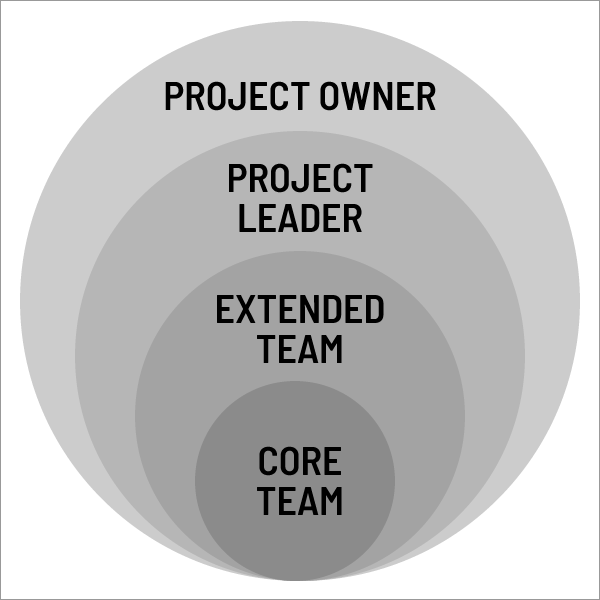
The core project team is extended to include all those whose contribution, co-operation and consent are vital to the successful completion of the project.
- Contribution means active and ongoing participation.
- Co-operation means providing ad-hoc assistance or, at the very least, not blocking progress.
- Consent means giving formal or informal approval to the proposed course of action.
Without these additional voices in the room, certain assumptions will go unchallenged, some beneficiaries’ interests and requirements will not be taken into account, vital pieces of the jigsaw will be missing, trust will be lacking and there could be trouble ahead.
Beyond in-person gatherings, digital channels are used to keep extended team members informed of developments and to gain their ad-hoc input.
Coherence is achieved by an insistence that the core team that remains intact for the entire project, led by the same person throughout.
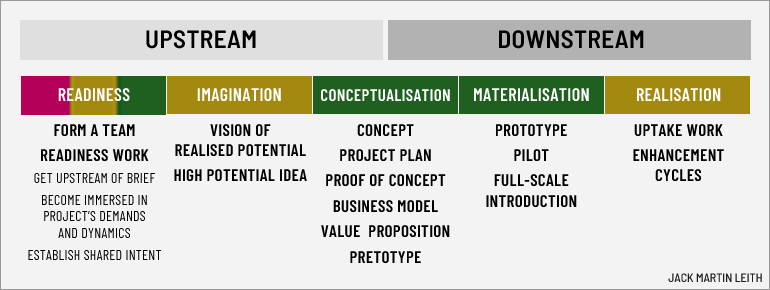
If it is necessary to have separate teams for the upstream and downstream parts of the project, the downstream project leader is included in the upstream team and vice versa, with the two project leaders accountable to an overarching project owner. This enables a seamless handover, ensuring continuity and coherence.
At an energetic level, imagination work and realisation (of value generation potential) work are inseparable, like magnetic poles.
The creators start with the end in mind and end with the start in mind, imagining the value they intend to generate and realising the intended value they imagined.
A disconnect here can give rise to a mediocre value generator with limited value generation potential.
Explore further:
Examine a typical Now-to-New project from start to finish
Readiness work sets the Now-to-New project in motion
Face-to-face meetings are convened for critical parts of the project
Online meetings using Teams or Zoom are sufficient for routine work such as progress reports, but the creators must meet face to face for critical parts of the project, notably Readiness, Imagination and Conceptualisation work.
Trust-based relationships cannot be established and sustained through video calls and online meetings alone.
Key aspects of face-to-face meetings in Now-to-New work
Trust and relationship buildingPhysical presence fosters trust and strengthens relationships, and in this context it’s considered more effective than digital-only interaction.
Effective knowledge sharing
In-person meetings enable the rapid, informal exchange of information and tacit knowledge that is hard to communicate via digital channels.
Organisational and systemic coherence
Face-to-face interaction is instrumental in fostering stakeholder co-operation and collaboration, breaking down communication silos and facilitating critical decision-making.
Five tests are applied throughout downstream work
Is the prospective creation desirable, feasible, viable, potent and fitting?
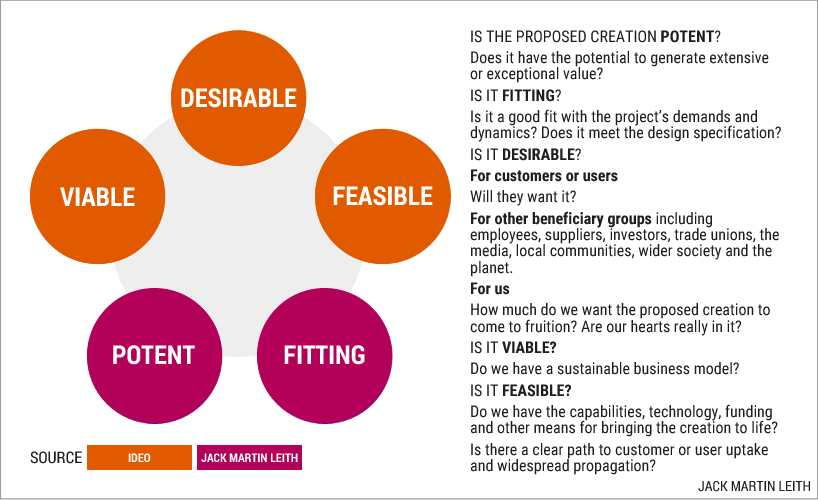
The global innovation firm IDEO popularised the three lenses concept represented by the orange discs. The lenses are labelled Desirability (Will people want it?), Feasibility (Can we make it and market it?) and Viability (Do we have a sustainable business model?).
I’ve expanded the definitions and added a two further items:
Potent
– Does it suggest the potential to generate extensive or exceptional value?
Fitting
– Is it a good fit with the demands and dynamics of the project?
– Does it meet the design specification?
The creators see the five items as tests rather than lenses. They conduct tests at key points throughout the Now-to-New project to ensure that further investment of talent, time, money etc. is justified, and – importantly – to advance the pursuit of greatness.
The creators know the maximum group size for a proper conversation is four
Now-to-New workshops observe the Max4 Principle. People work in groups of four, which are combined for concept discussion, enhancement and synthesis.
Explore further:
How to host a Knowledge Café and foster rich conversations
How to modify the Open Space meeting format to observe the Max4 Principle
Collusions of mediocrity are banished
Read the Substack article The Collusion of Mediocrity by Paul Levy, who has written extensively on the topic.The collusion of mediocrity describes how people collectively maintain comfortable conformity, suppressing excellence and risk in favour of social safety and superficial harmony.
Paul Levy
Great Readiness work
Projects don‘t so much go wrong as start wrong.
Bent Flyvbjerg, Emeritus Professor, Said Business School; Senior Research Fellow, St Anne’s College | His book Megaprojects and risk: an anatomy of ambition is considered essential reading for project managers, sponsors and those involved in megaprojects | Bent Flyvbjerg’s Wikipedia entry | Cited by Richard Claydon on LinkedIn | Minor syntax error corrected
Why Readiness?
For many years I referred to this chunk of work as Groundwork, but I changed its name to Readiness because its fundamental purpose is preparing fertile ground in readiness for the showing up of a promising value generation possibility and the conception of a high potential idea — one that is potent and fitting — for bringing the possibility to fruition.
Start the project right
Listed below are the 13 dimensions of Readiness work. Sequencing will vary from project to project. Some dimensions may not apply to your particular project. Some additional dimensions may be called for. And some will need to be reworked further along the path as new insights and understandings emerge.
- Understand the brief.
- Expose and challenge any assumptions present in the brief.
- Know the backstory and explore the wider context.
- Establish a clear line of sight.
- Get clear about your motive.
- Specify purpose and outcomes.
- Specify beneficiary value.
- Agree evidence of successful completion.
- Identify the non-negotiables.
- Identify genuine constraints to accomplishment.
- Expose and eliminate phantom constraints.
- Determine the critical success factors.
- Compile an inventory of assets.
Why Readiness work is an essential part of create-the-great projects
The creators get upstream of brief and root out any assumptions, cognitive biases and epistemological errors made by those who authored it.
They don’t take the brief at face value. Instead, they treat it as a discussion document, the agenda for a penetrating conversation.
No matter how set in stone it may appear, a brief is always provisional – nothing more than a first stab at specifying project requirements and providing supporting information.
By the time Readiness work is complete, the enhanced brief will have become a design specification for the work that lies ahead.
Readiness work immerses the creators in the project’s demands and dynamics.
Demands are the needs the project must satisfy — the value requirements, outcomes, deliverables and desired states of affairs.
Through their participation in Readiness work, team members become acutely aware of the needs that must be answered.
Dynamics refers to the moving parts, their relationships and the broadest context in which they operate.
Readiness work ensures that the Now-to-New project is consistent with the overarching business strategy, the innovation strategy, and any related initiatives that may be impacted.
Readiness work establishes shared intent.
Now-to-New work will proceed more swiftly and with greater determination when members of the extended project team are united by shared intent: a heartfelt desire to enrich the world, or a particular piece of it, in a particular way.
 The stage is now set for a potent and fitting idea to reveal itself.
Great Imagination and Conceptualisation work
The precondition for what follows is having Readiness work conducted by the extended project team in one fell swoop, with all members physically present in the room, and with visioning and idea conception work carried out immediately by the same group of people.A vision of realised potential is created
Following straight on from their Readiness work without interruption, members of the extended project team deploy natural imagining (not synthetic imagination) to envision a possibility for enriching the world or a particular piece of it with value, and doing this in a particular way.
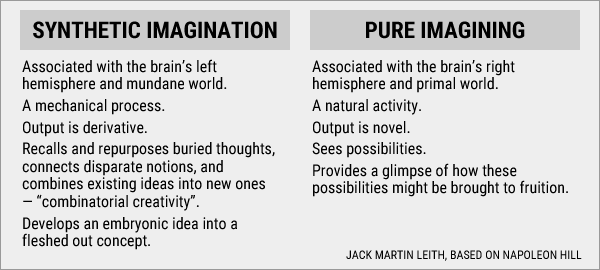
Read more about synthetic imagination and natural imagining
The imagined scenario is crystallised as a vision of realised potential. This is a depiction — an actual picture accompanied by a vivid and compelling synopsis — of how the world will look, sound and feel when the new creation exists in its finished state (even though the creators do not yet know what form it will take) and when its value generation potential is being realised without constraint.
The envisioned scenario portrays the broadest context in which the business, organisation, entrepreneur or activist exists, and it represents a desired present, not a desired future.
How the vision of realised potential is created
It is created collaboratively using a large sheet of paper taped to the wall. If possible, a professional graphic facilitator should lead this work.
The envisioned scenario portrays the broadest context in which the business, organisation, entrepreneur or activist exists, and it represents a desired present, not a desired future.I recommend the services of Creative Connection, which has on its books a range of experienced graphic facilitators from which you can make a selection. I do not have a commercial relationship with the firm and my association with principals Tim Casswell and Jennifer LaTrobe goes back a long way.
The picture is accompanied by a vivid and compelling synopsis. This is written in the present tense using sensory-based language, as though the author is describing a parallel reality he or she is experiencing right here, right now.
Any abstractions (e.g. engagement, culture, relationship, mindset, trust) and comparatives (better, improved, greater, increased etc.) are identified and eliminated.
The creators conceive a high potential idea for some ‘thing’ that will generate the envisioned value
Terminology: idea vs concept
Idea An initial spark, a sudden flash of inspiration, a glimpse of what could be, pointing towards a fruitful intervention, strategy, solution, programme of work or value generator, in accordance with the design specification.
High potential idea An idea that is both potent (it suggests the potential to generate extensive or exceptional value) and fitting (it meets the design specification).
Concept An explicated idea (“rudimentary concept”) or elaborated idea (“mature concept”).
The creators use the Idea-to-Concept Method
Work carried out up to this point should be sufficient for the practitioners to summon from their imagination an idea for a new creation with the potential to generate the requisite value for customers or users and other beneficiaries.
The idea may present itself as a mental image, rough sketch, 3D model, symbol or indescribable feeling, or in some other form.
The team’s ideas are captured, discussed and enhanced by means of the Idea-to-Concept Method.
Here, the creators work alone for a short while. They share their raw ideas in pairs and make whatever worthwhile modifications and enhancements come to light. Pairs then join with other pairs and merge their four ideas into one, if this seems the right thing to do. The enhanced ideas that emerge are shared in the large group and a final convergence is undertaken. Ideas that fell by the wayside earlier are revisited and incorporated if potential is revealed.
Read more about the Idea-to-Concept Method
Why brainstorming is not used
Brainstorming and other group-based diverge-converge methods lean heavily on the brain’s left hemisphere and synthetic imagination, employing recall, word association, analogy, repurposing, and combinatorial creativity, where existing ideas are combined to form a new one.
Ideas produced by means of synthetic imagination may eventually yield some degree of value, but they are often mediocre or derivative, with limited value generation potential.
In addition:
- An idea is conceived in the mind of a single individual, not in some fanciful group mind. Elaborating the bare bones idea may be a collaborative process, but conception is a solo act. Many music composers, graphic designers, journalists and other creative people work alone. This website is all my own work, from writing the words and making the graphics to handling all the technical WordPress stuff. I’m creating alone at this very moment, typing sentences that didn’t exist previously.
View a collection of quotes from songwriters, authors and others who create alone
- The format of a brainstorming session makes it hard for introverts, autistic people, other neurodivergent members of society and the socially anxious to contribute their ideas.
Explore further:
A collection of quotes about brainstorming’s shortcomings
Points to note
- Possibility and idea are equally important
- When undertaking Now-to-New work, possibility discovery always precedes idea conception.
Read more
Search the site
Not case sensitive. Do not to hit return.