What is perception?
Here are some of the many ways it has been defined.
- The process by which we take in and interpret the world through our senses, forming the basis of what we believe to be real.
- The lens through which we label things and assign value or worth.
- The meeting point of attention and imagination — a living act that shapes reality and gives rise to new possibility.
- The dynamic interplay between the world and the mind, where the mode of seeing determines the nature of what is seen.
- The awakening of awareness to what already is — the revelation of presence, wholeness and wonder.
What is pure perception and why does it matter?
I’ve created this article so you know what I mean when I use the term and to provide some resources that could be useful.
Pure perception is how we experience reality when we are situated in primal world.
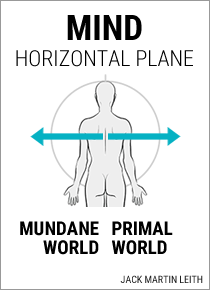
In primal world, free from the personal judgements, biases and preconceived notions that distort mundane world perception, we are part of the natural world and in harmony with the flow of the universe. All is one. There are no discrete things and therefore no names and no descriptions, allowing for a clearer and more objective view of things as they really are.
Read more about mundane world and primal world
Pure perception is found in various traditions and practices, including Buddhism and the Diamond Approach, where it is seen as a way to foster clarity and compassion by recognising the inherent value in all things and all beings.
I’m unable to say whether pure perception opens the door to primal world (pure perception as enabler), or if primal world is where we experience pure perception (pure perception as outcome). The two terms could be synonymous, interdependent, intertwined or mutually created. Concepts, labels and descriptions have no place here.
How might we attain pure perception and see what’s really there?
Of all the approaches outlined below, curiosity takes precedence. This is because it’s a persistent trait rather than a sporadic activity and, unlike Buddhism and Diamond Approach, it’s easily adopted with no devotion to a particular spiritual path demanded.
Curiosity
For the newcreator, questions are magical.
Wondering what I mean?
When someone says something you find disagreeable, you’re likely to react.Wonder Rapt attention or astonishment at something awesomely mysterious or new to one’s experience.
Merriam-Webster
But you’d be better off if you respond with a question, such as “That’s an interesting way of looking at it. How did you reach this conclusion?”
Reacting is an immediate, automatic and emotionally charged impulse rooted in survival, while responding is a conscious, deliberate choice made by pausing to reflect.
Curiosity acts as a bridge that transforms reactivity into responsiveness, shifting from defensive judgement to open-minded exploration of the “Why?” behind situations.
Don’t adopt this approach as a ploy. Be genuinely curious. It might not be necessary to give voice to the question. Asking it silently may be enough.
Make Be curious your mantra.
When you’re out and about, ask questions, either silently or out loud: What…? When…? Where…? Why…? Who…? How…?
Here’s a recent example.
I was travelling alone through the Somerset countryside on a bus, making my way from Bristol to Clevedon.
Through the window I spotted a line of huge electricity pylons stretching across the fields and into the distance.

Photo: National Grid
Instead of getting upset about the impact these alien structures have made on the rural landscape, I wondered:- Where do the power lines begin?
- Where do they end?
- How many pylons are there altogether?
- What’s the total distance covered?
- How did the residents of Tickenham respond when they first heard about the plans to instal the pylons?
- How do people feel now they’re in place?
I could easily have been judgemental about what I was witnessing, but the wondering made me part of the scene rather than a critical observer.
Curiosity is a habit that will help you be fully alive and in tune with intent.
Buddhism
Buddhism’s core teachings revolve around the Four Noble Truths and the Eightfold Path, which provide a guide to overcoming suffering and achieving enlightenment (Nirvana).
The Four Noble Truths are:
- The truth of suffering (Dukkha).
- The truth of the origin of suffering (Samudāya).
- The truth of the cessation of suffering (Nirodha).
- The truth of the path to the cessation of suffering (Magga).
- Right understanding.
- Right thought.
- Right speech.
- Right action.
- Right livelihood.
- Right effort.
- Right mindfulness.
- Right meditation.
Diamond Approach
The Diamond Approach is a modern spiritual path founded by A.H. Almaas that integrates Eastern spiritual wisdom with Western psychology. It focuses on self-exploration and uncovering one’s true nature through a practice of “inquiry” that involves directly sensing and experiencing one’s inner reality. While it has roots in Buddhist principles, it is a distinct path that explores spiritual realities like Essence, which is the personal and true nature of the soul, similar to the Hindu concept of Atman.
Read more about the Diamond Approach
Meditation
The main approaches to meditation can be categorized into three basic types:
Focused attention, open monitoring (mindfulness), and automatic self-transcending.
1. Focused attention meditation (Concentrative meditation)
This approach involves concentrating the mind on a single object to cultivate a quieter, more peaceful state of mind and improve concentration. When the mind wanders, attention is gently but intentionally brought back to the chosen anchor.
Common techniques include:
- Breath awareness: Focusing solely on the sensation and rhythm of inhaling and exhaling.
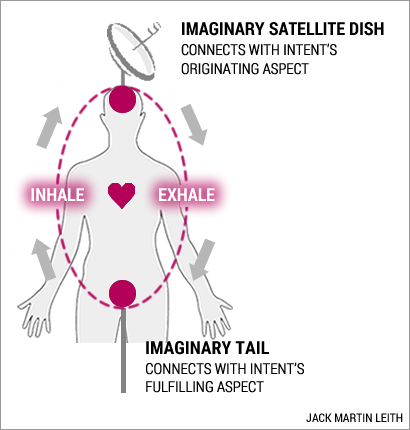
- Mantra meditation: Silently or audibly repeating a specific word, phrase, or sound (e.g., “Om” or a personal mantra).
- Visualization: Forming mental images of a calming place or positive scenes, engaging as many senses as possible.
- Object-oriented: Focusing attention on a physical object, such as a candle flame or mala beads.
- Body scan: Systematically focusing attention on different parts of the body to notice sensations and release tension.
This approach involves observing the contents of the mind and body without judgment or attachment. Practitioners train themselves to notice thoughts, feelings and bodily sensations as they arise and pass, staying in the present moment rather than dwelling on the past or future.
These are the eight aspects of mindfulness:
1. Nonjudgmental observation
2. Acceptance
3. Impartial watchfulness
4. Nonconceptual awareness
5. Present-moment awareness
6. Nonegotistic alertness
7. Awareness of change
8. Participatory observation
Source: 8 Basic Characteristics of Mindfulness by Laura K. Schenck based on Bhante Henepola Gunaratana
Common techniques include:
- Mindfulness-based stress reduction (MBSR): A structured program that uses a combination of mindfulness meditation, body scans and gentle yoga to reduce stress and anxiety.
- Vipassana meditation: An ancient form of insight meditation aimed at developing deep awareness of the body and mind through impartial observation of sensations.
- ‘Do nothing’ meditation: Pausing from activity and simply observing whatever thoughts and sensations arise naturally.
This category involves using an effortless technique, such as a mantra, to allow the mind to naturally settle down to a state of restful alertness, transcending ordinary thinking processes.
The most prominent form is Transcendental Meditation (TM), which uses a specific, personally assigned mantra and is typically taught by a certified instructor.
Some other approaches:
- Movement meditation: Also known as active meditation, this involves integrating mindfulness or focus with physical activities such as walking, yoga, or tai chi. See also OSHO Dynamic Meditation® and OSHO Kundalini Meditation®.
- Loving Kindness Meditation (Metta): Focuses on cultivating feelings of warmth, compassion, and kindness towards oneself and others.
- Guided meditation: A form where a guide leads the practitioner through a structured sequence, either in person or via a recording or an app. This method can be useful for beginners.
Presencing
Theory U is a conceptual framework. Presencing is its associated practice.Presencing is an invitation to be present in this moment, to this moment, not just what we think about it, but the felt knowing of our experience.
Arawana Hayashi, choreographer, performer, educator, author and co-founder (with Otto Scharmer) of Presencing Institute
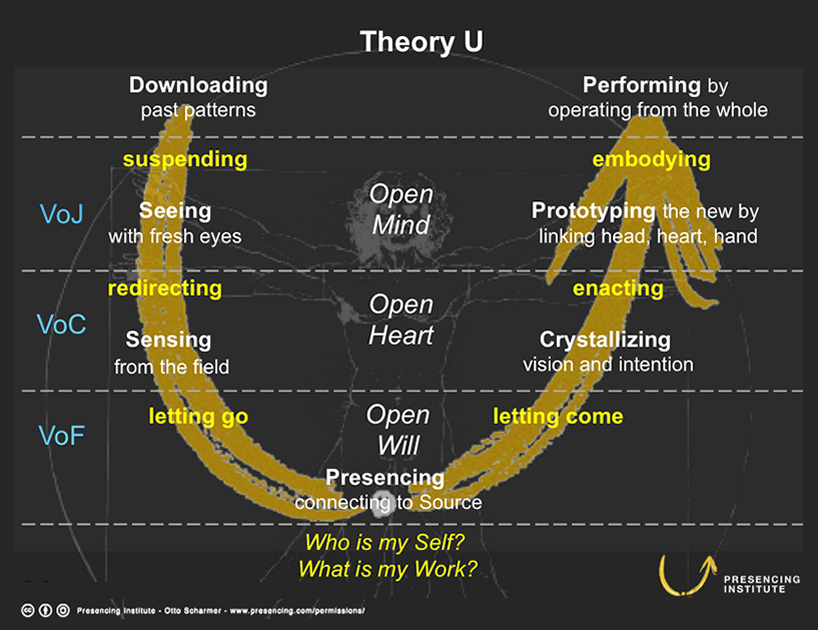
Blue type on left: VoJ is Voice of Judgment, VoC is Voice of Cynicism, and VoF is Voice of Fear | Click on image or here to enlarge
Key capacities to cultivate
1. Holding the space: Listen to what life calls you to do, creating a safe and open environment for dialogue and shared exploration.
2. Observing (Open Mind): Suspend the Voice of Judgment and past cognitive schema. Attend to the current reality with a mind wide open. This means truly seeing the world outside your ‘bubble’ with fresh eyes.
3. Sensing (Open Heart): Suspend the Voice of Cynicism. Connect with your heart and see things as interconnected wholes, developing empathy for others and for the entire system. Go to the ‘places of most potential’ and listen deeply.
4. Presencing (Open Will): Suspend the Voice of Fear. This is the core threshold at the bottom of the U. It involves letting go of old habits, beliefs, and non-essentials (like a camel passing through the ‘eye of the needle’ after unloading its burdens) and opening yourself to your highest future possibility. In a place of stillness and reflection, you connect to a deeper source of inspiration and allow ‘inner knowing’ to emerge.
Visit the Presencing Institute website
u-school for transformation | Part of Presencing Institute | Includes methods and tools for social transformation
Quotes
Objective Perception Means Pure Perception
The realization and understanding of space is necessary for the perception of objective reality—what we will call objective perception. Objective perception means perceiving reality, all that confronts our awareness, as it is. It is a matter of seeing things as they are, rather than seeing them from a certain point of view or position. So by objective we do not mean the scientific positivist sense, in which objective means what exists physically outside us rather than in the mind. We also do not mean objective in the sense of not being emotional, or not being experiential. We mean seeing things, seeing internal or external things, as they are, instead of subjectively. Subjective is the antithesis; it means according to our positions, feelings, filters, beliefs and attitudes. So objective perception means pure perception, free from all positions, bias, filters, conflicts, intentions, etc. It is perceiving whatever it is without any obscuration or intermediacy, so we see it just the way it is in itself.
What is Perception (Pure Perception)? | Diamond Approach Glossary of Spiritual Wisdom, from the teachings of A.H. Almaas
Imagine for a moment that your consciousness isn’t a product of your brain but rather something it receives. Your brain acts as an antenna, concentrating and interpreting signals from a vast sea of awareness. This radical shift in perspective questions everything you thought you knew about the nature of your mind.
But what happens if you remove or alter the receiver? If consciousness exists independently of the brain, changing your brain’s “tuning” could dramatically shift your entire reality experience. This concept opens up incredible possibilities for expanding human perception and understanding and gives you a powerful tool to alter the quality of your reality experience.Carl Gerber (aka Kristopher Raphael), Rewiring Your Reality — The Spiritual Path to True Perception | Explore his Flowing Zone Substack
Read about the radio analogy elsewhere on this website
An ordinary man sees the world as it is, as he’s been taught, conditioned and instructed to see it. A warrior sees the lines of the universe and knows the interconnectedness of all things.
don Juan Matus via Carlos Castaneda and Lorraine Voss
This philosophy of don Juan/Carlos Castaneda was developed through the use of hallucinogenic drugs1. By transcending ordinary reality one acquires wisdom of the right way to live. Ordinary reality, or the world view, is simply one interpretation of what really is. In order to stop the world “one has to learn the new description in a total sense, for the purpose of pitting against it the old one, and in that way break the dogmatic certainty, which we all share, that the validity of our perceptions, or our reality of the world, is not to be questioned”.
The Encyclopedia of World Problems & Human Potential | Union of International Associations
1. This is questionable; it is also irrelevant.
There is no truth. There is only perception.
Gustave Flaubert, author of Madame Bovary
If we are to move from relating to the world as fragmented parts to systemic wholes, we must change our basic way of thinking.
Not just what we think, but how we think. The change is:
- from abstract and symbolic conception…to acute and profound observation;
- from metaphorical thinking…to original and direct inquiry;
- from the habit of not looking freshly…to the discipline of finely tuned investigation; and
To make this shift, we must move from presuming to know before we look, to looking freshly without the limitation of a concept, metaphor, theory, or history of previous experiences.
- from reliance on concepts to bring a sense of order to the world…to an open quest to see what’s really there, even if it makes us feel uncomfortable, unsure, insecure, and mystified.
Another way to say this is: start with nothing, e.g. without an idea of what we might find.
Robert Fritz, in Reflections, The SoL Journal of Knowledge, Learning and Change, Vol. 5, Number 7 (no longer available online)
Read more
External sources
The Mind’s Four Doors of Perception, by Gregg Henriques, Ph.D. on Psychology Today website
Rewiring Your Reality — The Spiritual Path to True Perception by Carl Gerber (aka Kristopher Raphael)
What is Perception (Pure Perception)? | Diamond Approach Glossary of Spiritual Wisdom, from the teachings of A.H. Almaas
This website
How to transcend the mundane and awaken natural imagining
The newcreator’s embodied Now-to-New model | Download slideshow
The radio analogy. Not “Is it true?” but “Is it useful?”
Search the site
Not case sensitive. Do not to hit return.